Investigation
The primitives behind TesseraHow trails, outlines, fields, names, cited passages and layered reading led me from linked notes to attributed positions on one subject.
z2jpegkw2f · Working
Read full investigationTessera/ investigation
The primitives behind Tessera
How trails, outlines, fields, names, cited passages and layered reading led me from linked notes to attributed positions on one subject.
- Kind
- Investigation
- Permanent uid
- z2jpegkw2f
- Drawn
- Checked
- Approved
- Pending
- Graph / sources
- 2 in · 4 out / 15 sources
- State
- working
Markdown editors such as Obsidian are very good for writing. A note is still one scroll. I can link it to another scroll, follow a backlink, or inspect a graph. The graph, often dismissed as useless, does show something real: these notes connect. What it doesn’t show is how they connect, or why the connection matters.
I wanted Tessera to hold several analyses of one subject without making me reconstruct their relationship each time. A concept could have an opening account, attributed positions, supporting passages and a question still under consideration. These should stay distinct and readable together. That’s the note format in Multiperspectival notes.
Trails preserve associations. Outlines make structure navigable. Fields give relationships names. An index gets me back to a note by any of its names. Annotation keeps the evidence beneath a claim. These tools have long histories, and each solves a different problem while leaving something for the writer to do. Tessera’s design combines them and gives the relationships distinct roles.
Trails and views
In As We May Think, published in 1945, Vannevar Bush described a memex holding books, records and communications. Its distinctive operation was the associative trail. The reader joined items, inserted comments and branched into further material. An item could belong to several trails. Bush also gave the desk adjacent viewing positions, so one document could remain visible while another was consulted.
The route through material can itself be worth preserving. Bush’s trail gives me another way to find something again alongside filing. But association doesn’t explain its own meaning. I still have to say whether one joined item supports, disputes or qualifies the other.
Tessera keeps links and two working panes. Either pane can hold an editable note, a table or a reader. A source opened beside a claim stays in a working pane while I write. Both panes share one authored document.11Blocks and references in the domain model; prototype contracts. These implementation descriptions are pinned to 7afa21a, 12 October.
Engelbart and English’s 1968 account of NLS adds another useful distinction. Text was divided into addressable statements within a hierarchy. Names could stay with statements when their surrounding structure changed. View controls included level clipping, which limited the displayed depth, and truncation, which limited the displayed lines. The structure and current view were separate.
A present-day outliner makes that distinction easy to encounter. In Workflowy, zooming into a bullet makes it the current view and hides the rest of the document; breadcrumbs return to its parents. This gives a small part of a large outline room to work. The hierarchy gives it one parent and leaves its other relationships unexplained.
I keep folding, zoom and breadcrumbs in Tessera. A readable page doesn’t have to look like a list. Journal days keep their bullets; titled pages read as paragraphs, with thin threads showing their depth. Bullets return on hover or selection as zoom and drag targets. The same blocks support both arrangements.22Prose pages and depth threads; bullets and prose.
One node, several uses
A block in Tessera has an ID, a parent and an order among siblings. Moving it keeps that ID. A reference displays its current text, and backlinks record references to it. A task or study card attaches to the block and leaves the writing in place. The agenda opens the original task; changing a card’s wording keeps its review progress.1
Nelson’s 1965 hypertext paper describes interconnected written or pictorial material that can’t conveniently be represented on paper. His proposed file also allowed entries to participate in different lists. That raises a question beyond where a piece of text lives: what other arrangements can include it without needing a separate version?
Identity lets me reuse a block. I still need to say what it means. Tana’s supertags give a node a type and a template of fields, and gather similarly typed nodes into searchable collections and tables. A field names a dimension that a general link leaves implicit. An author field says more than a link between a book and another page.
Entering a field in Tana felt better to me than entering a block reference in Roam or Logseq: the field says what the connection means. In Tessera, I enter fields alongside the writing. A block or page shows its fields in one area beneath it, with an empty slot for each template field it hasn’t filled yet. Search has a permanent place above the panes, and a query either opens an existing page or explicitly creates one.33Types and fields; field areas; Find or create.
The model still has one atomic node that gathers types, fields and links. A concept is one kind of node; a perspective is another node linked to it. Field definitions, entries and values are themselves blocks. Types can supply field templates without requiring every member to fill them. Fields commit me to distinctions. Comparable values need comparable names; adding more links won’t do that work.
I’ve written separately about the slip box. Once a piece of writing has an ID and links, I want to know what else I can do with it and how much context it keeps elsewhere.
Names and finding aids
Links take me from one note to the next. I still need a way in. In the slip box as Ahrens describes it, a new note is made reachable from an index or another entry point, and its links lead on from there. Someone still has to keep that index.
Tessera derives its index from the notes, so no one keeps it by hand. A note’s kind says what it’s about. Person, Group, Concept and Thesis are built in; Question, Source and Project come from what the page already does, so they need no tag. A type I define can refine one of them, as Philosopher refines Person. Each kind opens a finding aid listing all its notes: titles in columns under letters, as at the back of a book. Person, Group and Concept start with field templates that stay empty until I want them.44Kinds and aliases in the domain model; finding aids. Kind index and finding aids: 2b5c32b; aliases and name resolution: 2046a20.
Names complicate this. Cicero is also Tully, and in a library catalog he’s “Cicero, Marcus Tullius”. An alias is another whole name for a note. Completion, Find and a hand-typed [[Tully]] all reach Cicero, and the finding aid lists the alias as a cross-reference: Tully, see Cicero. An imported book’s creator links to the person page it names instead of creating a second one. When two pages share a name, Tessera leaves it unlinked and marked rather than guessing; choosing one links it and keeps the import’s spelling as another alias. Merging two pages leaves the title that went away as an alias of the one that stays.4
A finding aid gets me back to Cicero. It doesn’t tell me what Cicero thought about anything, or how his account differs from Polybius’s. Positions do that work later.
Reading and keeping the evidence
A reference to my own writing should usually follow an edit. A quotation from a book should stay as I read it. A reading notebook needs to point to that passage, beyond identifying the work or its current text.
The W3C Web Annotation model describes a TextQuoteSelector using the exact selected text, with text before and after it to distinguish repeated occurrences. It also treats the intended state of a changing resource separately from the selection. Even for a short quotation, identifying the words and preserving the version containing them are different jobs.
Tessera’s library keeps immutable, content-hashed snapshots. Original files stay in the notebook’s object store. Extracted structure and passages belong to that snapshot, separate from the editable outline. A cited highlight is an authored block whose citation names the source, snapshot and passage. New ingestion can add another snapshot while leaving the old citation on the same text.55Sources, snapshots and passages; the Highlights desk; library stage. The reader capture includes reading-position progress and narrow headers and source marks.
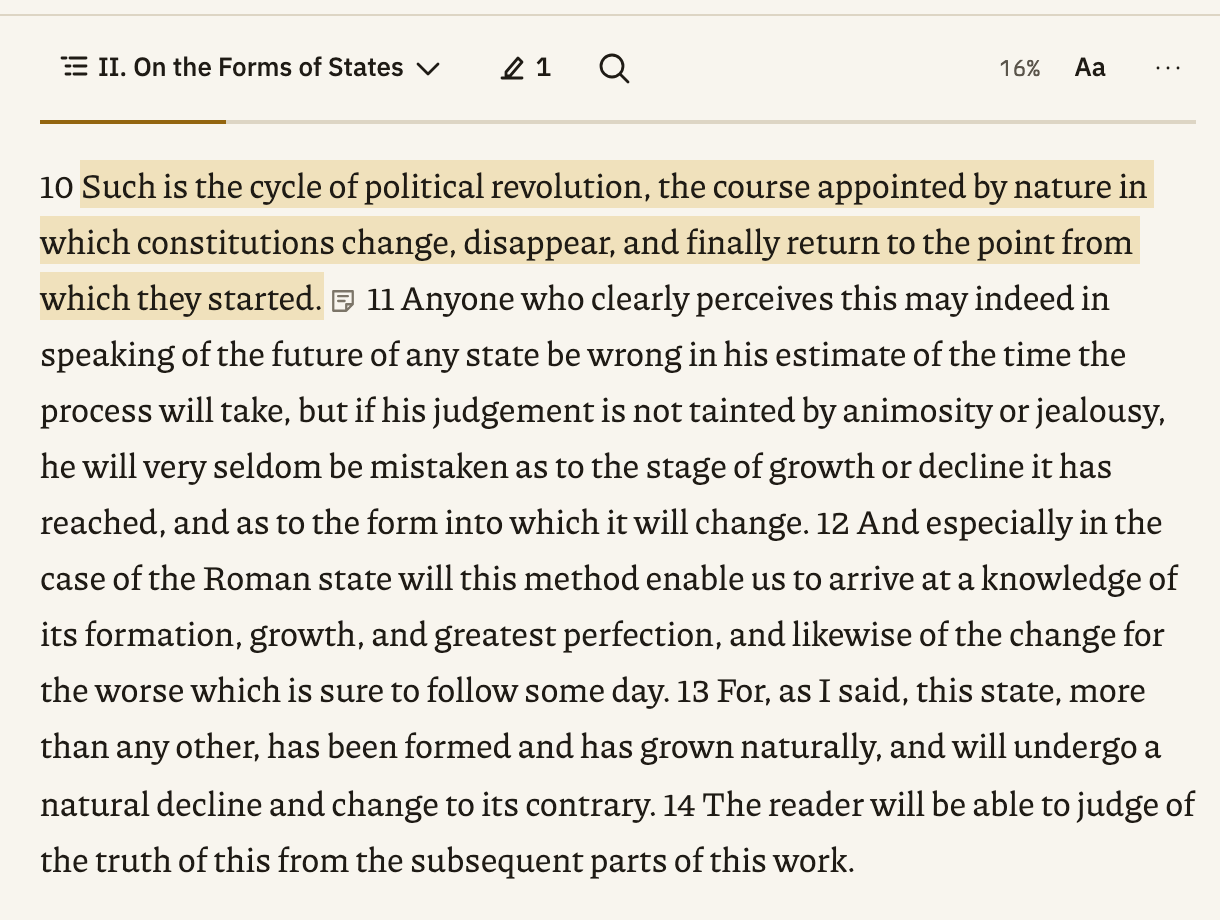
The reader opens beside the notes. A selection makes a cited block on the source page; my explanation or a card can grow beneath it. Metadata stays in ordinary fields. The library arranges sources by reading state, saved views and hand-made collections. Its Highlights tab is a desk for quotations that haven’t yet acquired a note, card or incoming reference: it takes them in reading order, with the passage and what follows it beside the queue. The evidence stays available as I work on its interpretation.5
That takes storage, and I have to keep my writing distinct from the source’s words. An ordinary revision then can’t silently rewrite the basis of a claim. A quotation can remain evidence even when I change my account of it.
Tessera now draws the same line inside my own writing. A reference within a sentence shows its target’s current text. A row that holds nothing but ((…)) is a quote instead: it keeps the block and its children as they stood when I quoted them, behind a hairline rule, with the source page and the capture date beneath. If the original changes, the quote says so and offers Update; it doesn’t follow on its own. Blocks beneath a quote are ordinary notes on it. A passage citation needed no such rule, since a snapshot’s passages never change.66Quotes in the domain model and their design; frozen quote rows: 0512873, 655def6.
Zotero’s citation styles are written in Citation Style Language. Bibliographic data can stay separate from a finished citation string. Tessera exports source fields as CSL JSON or BibTeX. I prefer links on the words a claim rests on to bracketed author-year interruptions, as on this page. That changes presentation. I still need authors, titles, locators and recoverable evidence.
Returning to what I read
Keeping a passage doesn’t ensure I’ll return to it. Remembering a particular answer and coming across an earlier reading again are different needs; they should have separate queues.
In his history of SuperMemo, Piotr Wozniak dates his first repetition algorithm to 1985 and the first computer implementation to 1987. The useful step is scheduling recall of an item. RemNote’s notes-as-cards keep that item within the notes: a bullet’s question and answer can become a flashcard, then enter spaced-repetition practice.
Tessera also derives cards from authored block text. Each direction or numbered cloze has its own identity and progress. A descriptor card, as in RemNote, asks about a child in its parent’s context: under Mitochondria, Function ;; makes ATP shows “Mitochondria › Function” and asks for “makes ATP”. A type can carry a card template, so each member makes its own card once it has the fields the template uses. Wording changes keep the existing card by default. Review records retain the text shown and the grade, and the review pane can return to the source block. Scheduling uses FSRS, which builds each card’s memory state by replaying its past grades.77Cards and retained review evidence; descriptor cards: fe89714; FSRS: 42eb974; card templates: 9203919; journal highlight resurfacing; Highlights desk.
This saves me from copying the same thought into an unrelated deck to practize it. I still have to formulate a question. A reviewable question is narrower than a page explaining an idea; turning everything into cards wouldn’t make the page more readable or settle its disagreements.
Highlight resurfacing brings me back to earlier reading. Readwise’s Daily Review brings earlier highlights back and lets the reader tune how often documents appear. Tessera resurfaces older highlights in the journal, with their source and location. The Highlights desk provides another route back to quotations waiting for work.7
Notes need a queue of their own. In the design I’ve settled on, a note can carry a revisit date and come back on that day to be read as writing, with its sources and backlinks at hand. A revisit has no grade, because it judges the note rather than my memory of it. I can mark it revisited, move it later, or settle it as something I stand behind. That part is designed and not yet built.88Note state and revisits in the domain model; notes stage, which lists the note capability, its revisits and the notes queue as remaining.
I read books, highlight and make cards. I also want a local model to help draft pages and quiz me. An agent can now read the notebook and write to it through the same operations I use. Each change carries the agent’s name, and I can undo it from Settings. I still want to write the prose myself, because drafting is how I learn to express an idea. A returned quotation or a due card should help me do that writing.99Changes and attribution; the trust stage lists what agents can read and write through tessera mcp and the agent API. Reversible agent edits: 769c4df.
A page at several depths
An outline can hide detail, but structural depth and reading depth differ. A child block may contain the crucial explanation; a top-level heading may assume knowledge I don’t yet have. I want a note that teaches without showing its whole apparatus at once, then brings more into view as curiosity grows.
I’m thinking of lore hovers in modern isometric role-playing games. An unfamiliar word can offer a short explanation without sending me away from the sentence. I can keep reading or follow that explanation; I don’t need to understand everything before I begin.
The Glossa Ordinaria offers an older precedent: it placed commentary around and between the lines of the biblical text. Text and explanation could share a page and keep their voices distinct. Having it all nearby could also overwhelm a first reading.
Tessera’s gloss is an ordinary field shown beneath a titled page and in reference previews. A four-stop dial controls how much of the page appears. Gloss shows the short account alone. Opening adds the text before the first top-level heading. Perspectives adds headings and compact positions. Full reveals the outline. The setting changes what I see, keeps the stored page intact and returns with the pane’s history.1010Gloss and four-stop depth dial; gloss and depth rules.
Anacyclosis
Polybius's cycle of constitutions.
The authored gloss alone.
Anacyclosis
Polybius's cycle of constitutions.
Kingship gives way to tyranny, aristocracy to oligarchy, and democracy to mob rule.
The gloss and text before the first top-level heading.
Anacyclosis
Polybius's cycle of constitutions.
Kingship gives way to tyranny, aristocracy to oligarchy, and democracy to mob rule.
Perspectives
Plato
A line of decline, not a circle
Polybius
A cycle by nature, slowed by mixing
Ibn Khaldun
Dynasties rise and fall over three generations
Shown headings and compact positions. Three of six shown here.
Anacyclosis
Polybius's cycle of constitutions.
Kingship gives way to tyranny, aristocracy to oligarchy, and democracy to mob rule.
Perspectives
Plato
A line of decline, not a circle
Polybius
A cycle by nature, slowed by mixing
Ibn Khaldun
Dynasties rise and fall over three generations
The complete outline, including fields and evidence. Excerpt shown here.
Visibility changes. Block identity and authored text do not.
I still have to write a good gloss, choose the opening and make each position’s gist faithful. The dial gives these authored forms a place to coexist. I can use paragraphs for an account intended to be read and bullets for quick journal notes without losing the underlying structure.
Source marks make the apparatus more compact. In critical editions, sigla identify textual witnesses. Tessera uses the same short-mark principle for sources, normally three capitals from the first author’s family name, with an authored override. The marks help me navigate; full citations remain. The margin’s source key expands them back into titles.1111Source sigla; three-letter defaults; derivation and collision rules.
From links to positions
A backlink tells me that a note mentions another note. Tessera’s backlinks now group those mentions by page, can open the blocks around each one, and list unlinked mentions of the page’s title or aliases. A graph shows a connection. I still need to know whose analysis I’m reading, what it says about the subject, and which disagreement I should compare with it. Trails, blocks, fields, names, quotations and views leave that gap.1212Backlinks and unlinked mentions; f4a9236.
The closer ancestor is Kunz and Rittel’s 1970 IBIS. It organizes deliberation around issues, positions responding to them and arguments supporting or objecting to those positions. Conklin and Begeman’s account of the method makes those relationships explicit. A connection has a role within an inquiry.
The cost is that I have to author these roles. Filing something as a position is already an interpretation. A reading notebook can also explore subjects that aren’t decision problems. Tessera lets a position concern a concept as well as a question, while keeping the holder and evidence that distinguish it from my own conclusion.
A position is an ordinary block with that capability attached. Its first link identifies the holder; another can file it under a subject elsewhere. Gist supplies a short account. Work names the source, or a passage cited beneath it supplies one. A position can stay under the highlight that prompted it and still appear among the concept’s readings.1313Positions, holders, gists and the first Compare; constellation margin; perspective design.
Polybius
Such is the cycle of political revolution, the course appointed by nature in which constitutions change, disappear, and finally return to the point from which they started.
W. R. Paton · 1923 · 6.9.10
The cited highlight keeps the source, snapshot and passage.
POL Polybius → Anacyclosis
- Gist
- A cycle by nature, slowed by mixing
- Work
- Histories · 6.9.10
- Shape
- Circle
First link: holder. Second link: subject. Fields remain ordinary children.
Anacyclosis
Perspectives filed elsewhere
POL Polybius
A cycle by nature, slowed by mixing
The concept finds the same position. It does not acquire a copy.
For a subject such as Anacyclosis, Compare has two tabs. Readings sets the positions I choose side by side, one column each: siglum, holder, work, gist and my account of the reading. Criteria keeps those columns and turns the rows into the subject’s criteria, such as Shape, Engine and Exit. A subject can keep its own ordered set of criteria; until I save one, Compare derives the set from the positions’ fields. Each cell is the position’s authored value, and I can edit it in place.
The first version of Compare marked columns where every value differed. Different wording alone doesn’t establish a disagreement, so the matrix now marks only cells whose text is identical. Each such repeat gets a number and a footnote naming the sigla that share it, much as a critical apparatus identifies the witnesses which have a reading. Whether two readings agree in substance is still my call.1414Subject criteria and the criteria matrix, 11 October; Compare design; criteria in the domain model.
6 of 6 holders · 3 subject criteria · 3 questions
| Criterion | PLAPlatoRepublic | ARIAristotlePolitics | POLPolybiusHistories | CICCiceroOn the Commonwealth | MACMachiavelliDiscourses on Livy | KHAIbn KhaldunMuqaddimah |
|---|---|---|---|---|---|---|
| Shape | line | many paths | circle≡ 1 · exact repeat | circle≡ 1 · exact repeat | circle, rarely completed | rise and fall |
?What shape does the sequence take?Shape · all 6 | ||||||
?How often does the cycle run its full course?Shape · POL ↔ MAC only | ||||||
| Engine | The faults of each ruling class | Faction and inequality | Each form's corruption | The faults of rulers | Corruption, then conquest | Group feeling lost to luxury |
?What drives the change from one stage to the next?Engine · POL ↔ KHA only | ||||||
| Exit | None given past tyranny | A well-mixed constitution | A mixed constitution slows it | A balanced mixture | Well-ordered institutions | None; a new group takes over |
≡ 1 Identical authored value: "circle" · POL, CIC
Only identical text is marked. Different wording says nothing about agreement.
A question that names a criterion follows its row, scoped to the holders it links.
A question beneath the subject that names a criterion follows that row, scoped to the holders it names, or to all of them. The scope is part of the row: Shape · all 6, or Shape · POL ↔ MAC only. The positions and the question sit together where the difference can be read.14
I wanted several analyses of one topic linked to it and ready to compare. The constellation margin gives that subject a local map. Holders sit around the page, incoming linked pages form an outer ring, and the source key stays nearby. It appears only when the pane has room and the page has enough perspectives. The positions and comparison explain the relationships the graph alone leaves open.13
Questions and conclusions
A position attributes someone else’s claim. An assessment records my dated answer to a question. Keeping those apart lets me compare the readings before accepting an answer, and revisit that answer without erasing what I previously thought.
Some questions can be answered once. Others recur, and some may end in aporia. Tessera gives a question four states: open, answered, parked and unsettled. Answered follows from an accepted assessment. Parked pauses the question. Unsettled keeps it open by design, even when it has a current accepted reading, and it can carry a date for its next review. Accepting another assessment supersedes the previous one but leaves it readable. An answer can also record aporia: a dated finding that no answer holds yet. A question can be a single block or a whole titled page.1515Question states and answers; dated assessments and state derivation.
What shape does the sequence take?
No accepted assessment yet.
Plato: line
Polybius: circle
A question can gather evidence before an answer is accepted.
Where does Plato's sequence end?
In tyranny. It doesn't return to its beginning.
Republic · bk. 8
Answered follows from the accepted assessment. It is not a separate stored verdict.
How often does the cycle run its full course?
Rarely, for Machiavelli. A weakened state is usually conquered first.
Discourses on Livy · I.2
Pause the question. Resume it before accepting an assessment.
What drives the change between stages?
Polybius traces constitutional forms. Ibn Khaldun traces dynasties and group feeling.
Histories · 6.9.10
Muqaddimah · ch. 3, §12
Compare their shapes first: circle against rise and fall.
Review · 2026-11-06
The current reading can be accepted without closing the inquiry. The earlier one remains readable.
I keep this separate from tasks and cards. A question can stay open without becoming unfinished work or a failed recall. Its dated assessments preserve the current reading; its state says whether I consider the inquiry closed, paused or still open.
Making the model usable
Building it tested these distinctions. The earlier prototype took 9.5 seconds to autosave a 2,000-block page. Browser recovery exhausted storage after thirty edits on the large page. Tessera kept the behavior contracts and replaced the implementation. Checked operations now act on changed blocks, leaving the rest of the page alone, and a stale revision writes nothing.1616Measured prototype baseline and editor spikes; rewrite lessons; Solid decision.
Editor spikes compared React and Solid with CodeMirror against a single ProseMirror document. Both CodeMirror versions passed the correctness cases; ProseMirror failed the Vim cases. Solid added less list-reconciliation work, so I chose it. None of the variants made mounting 10,000 rows cheap. I still had to reduce unnecessary work.16
The same rules now have to hold on more than one device. Tessera runs on my Mac and on an Android phone that syncs with it over my tailnet, and a separate notebook can live in a browser. Every change carries its own ID and the device it came from, so each device reaches the same state from the same changes. When two devices edit the same text offline, both versions survive as copies for me to settle. Journals for the same day and pages with the same title merge.1717Sync design, including identity and determinism and conflicts; sync stage. The browser build doesn’t sync.
The notebook depends on these rules. For references to work, a block needs to keep its identity through edits. Two working panes need shared state. Cards need history distinct from wording. A later assessment has to leave the earlier one readable, and a newer snapshot has to leave an old passage citation intact. A change made on the phone has to mean the same thing on the Mac.
I make and revise these relationships in Tessera and publish readable accounts on this site. I wanted that route from a passage to a highlight, from the highlight to an attributed position, and from compared positions to my own prose.
Footnotes
-
Blocks and references in the domain model; prototype contracts. These implementation descriptions are pinned to 7afa21a, 12 October. ↩ ↩2
-
Kinds and aliases in the domain model; finding aids. Kind index and finding aids: 2b5c32b; aliases and name resolution: 2046a20. ↩ ↩2
-
Sources, snapshots and passages; the Highlights desk; library stage. The reader capture includes reading-position progress and narrow headers and source marks. ↩ ↩2
-
Quotes in the domain model and their design; frozen quote rows: 0512873, 655def6. ↩
-
Cards and retained review evidence; descriptor cards: fe89714; FSRS: 42eb974; card templates: 9203919; journal highlight resurfacing; Highlights desk. ↩ ↩2
-
Note state and revisits in the domain model; notes stage, which lists the note capability, its revisits and the notes queue as remaining. ↩
-
Changes and attribution; the trust stage lists what agents can read and write through
tessera mcpand the agent API. Reversible agent edits: 769c4df. ↩ -
Source sigla; three-letter defaults; derivation and collision rules. ↩
-
Positions, holders, gists and the first Compare; constellation margin; perspective design. ↩ ↩2
-
Subject criteria and the criteria matrix, 11 October; Compare design; criteria in the domain model. ↩ ↩2
-
Question states and answers; dated assessments and state derivation. ↩
-
Measured prototype baseline and editor spikes; rewrite lessons; Solid decision. ↩ ↩2
-
Sync design, including identity and determinism and conflicts; sync stage. The browser build doesn’t sync. ↩
References
- Ahrens, Sönke. 2017. How to Take Smart Notes. CreateSpace.
- Bjornstad, Soren. n.d. “Flashcard Basics.” RemNote Help Center. Accessed October 6, 2026. https://help.remnote.com/en/articles/8663109-flashcard-basics.
- Bush, Vannevar. 1945. “As We May Think.” The Atlantic Monthly, July. https://www.w3.org/History/1945/vbush/vbush-all.shtml.
- Conklin, Jeff, and Michael L. Begeman. 1988. “gIBIS: A Hypertext Tool for Exploratory Policy Discussion.” https://www1.in.tum.de/lehrstuhl_1/files/teaching/Lehrstuhl/DesignRationaleWiSe2003/conklin_1988.pdf.
- Engelbart, Douglas C., and William K. English. 1968. “A Research Center for Augmenting Human Intellect.” AFIPS Conference Proceedings 33. https://dougengelbart.org/pubs/papers/scanned-original/1968-augment-3954-A-Research-Center-for-Augmenting-Human-Intellect.pdf.
- Kunz, Werner, and Horst W. J. Rittel. 1970. Issues as Elements of Information Systems. Working Paper No. 131. Institute of Urban and Regional Development, University of California, Berkeley. https://escholarship.org/uc/item/5cj786v8.
- Nelson, T. H. 1965. “A File Structure for the Complex, the Changing and the Indeterminate.” Proceedings of the 1965 20th National Conference. https://doi.org/10.1145/800197.806036.
- Readwise. n.d. “Reviewing Your Highlights.” Readwise Docs. Accessed October 6, 2026. https://docs.readwise.io/readwise/docs/faqs/reviewing-highlights.
- Sanderson, Robert, Paolo Ciccarese, and Benjamin Young, eds. 2017. Web Annotation Data Model. W3C Recommendation. World Wide Web Consortium. https://www.w3.org/TR/2017/REC-annotation-model-20170223/.
- Sloane, C. O’C. n.d. “Glosses, Biblical.” In New Catholic Encyclopedia. Accessed October 6, 2026. https://www.encyclopedia.com/religion/encyclopedias-almanacs-transcripts-and-maps/glosses-biblical.
- TEI Consortium. 2026. “Critical Apparatus.” TEI P5: Guidelines for Electronic Text Encoding and Interchange, July 28. https://www.tei-c.org/release/doc/tei-p5-doc/en/html/TC.html.
The wit attribute identifies the witnesses which have the reading in question.
- Wozniak, Piotr. 2018. “History of SuperMemo.” SuperMemo Guru, June. https://supermemo.guru/wiki/History_of_SuperMemo.
- Zotero. n.d. “Citation Styles.” Zotero Documentation. Accessed October 6, 2026. https://www.zotero.org/support/styles.
Linked from · 2
Multiperspectival notesInvestigation
…has a constellation in its apparatus margin when the pane is wide enough. I wanted these tools to help me turn reading into my own prose. The primitives behind Tessera traces their interface lineage and the move to attributed positions. The claims, sources and distinctions I make in Tessera should survive…
TesseraProject
The primitives behind Tessera traces how trails, outlines, fields, cited passages and layered reading led to attributed positions on one subject. Multiperspectival notes…