Investigation
Multiperspectival notesHow a concept note keeps several sources' readings distinct, from a passing hover to a side-by-side comparison, and how that design now works on this site and in Tessera.
ft80mfnwv5 · Working
Read full investigationInvestigation/ folio
Multiperspectival notes
How a concept note keeps several sources' readings distinct, from a passing hover to a side-by-side comparison, and how that design now works on this site and in Tessera.
- Kind
- Investigation
- Permanent uid
- ft80mfnwv5
- Drawn
- Checked
- Approved
- Pending
- Graph / sources
- 4 in · 6 out / 6 sources
- State
- working
A good concept note lets me see several ways of thinking about it at once. Take a note on daimon, or on how the Greek word became our “demon”. It gathers philosophy, religion, translation and centuries of reuse, and collects a great many links. Most of that doesn’t belong in the quick card that appears when the word comes up elsewhere. I’m thinking of the lore hovers in modern isometric RPGs: a passing reader needs a sentence; one who stops needs the whole argument.
I wanted the same note to serve both, without keeping a glossary definition apart from the fuller account. I also wanted several authors’ readings to meet and stay distinct. The reading sheet on anacyclosis now does that on this site. Tessera, where I’m building the making side, has glosses, attributed perspectives and comparison too.11The site reading sheet landed in 2d6eb35, followed by sigla and hidden empty assessments in 854ff48, 6 October. Tessera’s glosses and positions landed in 9677271 and 64de8af that day.
Three models
The first is the Zettelkasten, the sociologist Luhmann’s slip box, as Sönke Ahrens describes it: notes on what you read, in your own words, and permanent notes organized through links rather than topics. For a new note, the question is where you’ll want to come across it again.
The second is Andy Matuschak’s evergreen notes. They’re atomic, densely linked, and have titles that work like function names, so one note can call another. They’re organized by concept rather than by book, which is close to what I want. When a second book discusses a concept, its view lands beside the first one and has to meet it. Matuschak asks whether the two are in tension, and whether some distillation only becomes visible when both are considered together.
The third is Robert Andrew Martin’s Molecular Notes. Its pieces are Sources, Atoms, Molecules and Topics. An Atom is an existing concept in your own words, the kind of thing that could have a Wikipedia page; a Molecule is an insight, usually a few sentences, built from Atoms; Topics are empty notes that anything can link to. Martin also warns against complicated metadata. His notes carry three fields. I share that impatience: I don’t want to spend my time on fields, tags, types, or deciding whether one note has another or is one.
Where I differ
My use of “molecular” differs from Martin’s. I think of several parts of a topic bubbled up together. His Atoms are deliberately brief, and Matuschak’s notes are deliberately atomic. I want a note that can hold Plato, Polybius and Ibn Khaldun at once, so I can see their readings together before deciding what I think.
The risk is that it becomes an encyclopedia article. Its purpose and attribution keep it a working note. Each perspective is my account of a particular source, with passages to check it against. The differences stay visible. I keep my own conclusion in another section so it doesn’t quietly speak for everybody.
This needs some structure, despite my impatience with metadata. A holder and a gist let me recognize a reading. A few shared fields let me compare it with another. I want fields that answer questions I’m already asking, without imposing a complete schema on every note.
Anacyclosis on the page
Anacyclosis is Polybius’s name for the cycle of constitutions. It’s a useful test because the neighboring accounts aren’t all describing the same thing. Plato’s decline of the city isn’t a circle. Ibn Khaldun’s dynastic lifespan concerns generations and group feeling rather than a sequence of constitutional forms. I gather them under one concept to compare them.
The live note carries all six readings and their citations. It opens with a definition of the term. Below it, each holder has a picker with a one-line gist and a drawn shape: a line, a circle, many paths, or a rise and fall. The shapes make differences visible before I start reading the prose. The attributed slips follow.
Anacyclosis
Polybius's cycle of constitutions. Kingship gives way to tyranny, aristocracy to oligarchy, and democracy to mob rule.
The shapes name the difference before the full prose begins. Select two or more holders on the live sheet.
Plato
The ideal city's decline runs through timocracy, oligarchy and democracy into tyranny. The sequence is a line, not a circle.
Choosing two or more holders changes the sheet into aligned columns. Plato beside Polybius gives each reading its own column, then compares shape, engine and exit row by row. Polybius’s Greek passage stays beside its translation and attribution. The question of what shape the sequence takes appears at the shape row, where the difference can actually be seen.
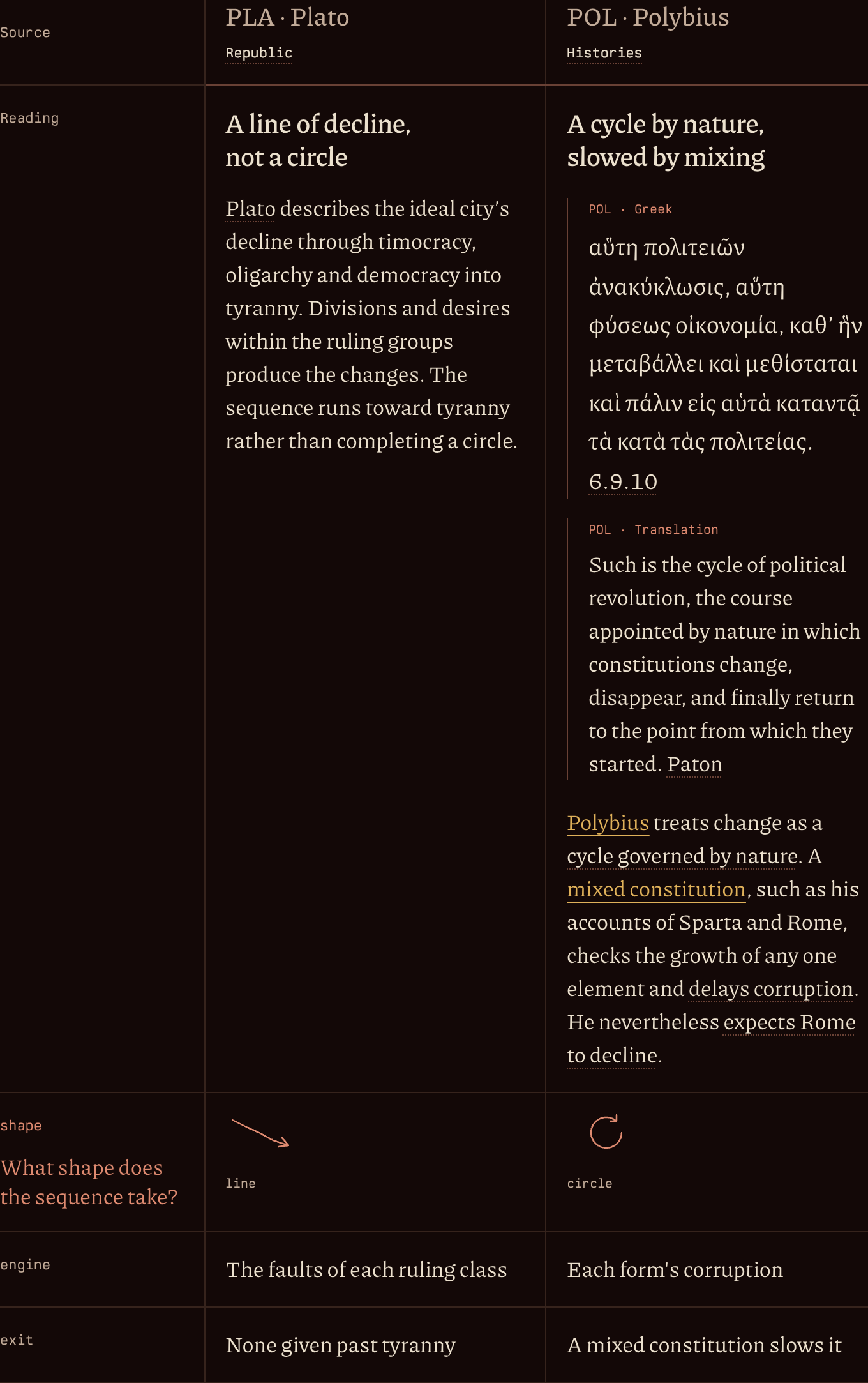
The selection stays in the address, so I can link to a comparison without describing a sequence of clicks. Clearing it returns to the slips. The readings stay separate, leaving the verdict to me. The arrangement gives me somewhere to begin.22The site’s README documents selection, compare addresses, passages and the stacked reading without JavaScript; the renderer builds the sheet from the Markdown.
Choosing the reading view
Before the sheet was built, I tried three topic-web directions. They used the same example and gave the reader different jobs.
A, Focus and orbit, put the concept at the center, its holders around it, and related concepts farther out. Opening a holder brought its text into a reading margin. The surrounding relationships were visible, but I had to move between the web and the slip to read.
B, Lenses on a sheet, began with the note itself. A row of perspectives led into comparison, while related notes could open alongside it.
C, Compose a web, began with a canvas. I could add perspectives and concepts, arrange their cards, and keep the composed view in its address.
A · Focus and orbit
Start with the web
A cycle by nature, slowed by mixing.
Choose a holder, then read beside the web.
B · Lenses on a sheet
Start with the prose
Anacyclosis
Polybius's cycle of constitutions.
PLAA line of decline, not a circle.
POLA cycle by nature, slowed by mixing.
The note is the entrance. Comparison opens within it.
C · Compose a web
Start with an arrangement
A line of decline
A cycle by nature
Keep selected readings and a related concept in view.
I chose B for ordinary reading. I wanted the sources’ words, including original-language passages, to have a place on the page without a tour through a graph first. It also seemed the easiest view to make from existing Markdown notes. C is still a direction for a later workspace.
A handful of arranged cards isn’t yet a way to work through a library of full books. I want to read, highlight, write prose and make drills without forcing all of those activities into a canvas. The mockups helped me separate the page I can publish now from the larger workspace I still need to think through.
One Markdown sheet
The shared contract describes one node model with two surfaces. Tessera gives blocks capabilities and links; this site gives a reader notes and pages. A perspective can be its own node in Tessera without needing a separate public page here. On the site it lives inside the concept, with an anchor, and its resolved holder note lists it under “Perspectives held”.33The 6 October shared contract and three topic-web mockups are saved with the design study. The excerpt comes from the anacyclosis note’s own source file. The contract describes the intended export, not a shipped exporter.
The published sheet is one ordinary Markdown file. Frontmatter marks it as a concept and supplies the summary. Under ## Perspectives, each ### Holder begins a reading. The anacyclosis file has:
## Perspectives

### Plato
source:: [Republic](@plato1992republic "bk. 8")
gist:: A line of decline, not a circle
shape:: line
engine:: The faults of each ruling class
exit:: None given past tyranny

[Plato](@plato1992republic "bk. 8") describes the ideal city's decline through timocracy, oligarchy and democracy into tyranny. Divisions and desires within the ruling groups produce the changes. The sequence runs toward tyranny rather than completing a circle.
The gist names this reading. The source attributes it. Shape, engine and exit are criteria; another concept can use other lowercase key:: value fields. A criterion becomes a compare row when at least two perspectives provide values. The prose remains ordinary Markdown, with wikilinks and citations.
Passages begin with > [!passage]. An original and a translation can share a callout while each keeps its own citation and locator. The renderer recognizes Greek by its script; the marker can name other original languages. The short margin codes are sigla. This site uses three-letter defaults such as PLA, POL and IBN, can read a source’s CSL citation-label, and accepts an authored siglum:: override. These marks keep the attribution beside a long passage without repeating a full title.
I write the questions under ## Where they disagree. Each names a criterion. The renderer decides whether to show it from differences in that field, with an optional restriction to particular holders. Different wording alone doesn’t establish a substantive disagreement. I still have to choose comparable values and write a useful question. The code keeps the arrangement honest; I do the interpretation.
## What I make of it has its own section. It accepts an assessment date and stays hidden until I write something. There’s no assessment on the anacyclosis note yet.
The site’s sheet and Tessera’s structured positions are both implemented. They share a format contract; concept export between them is still work to do.
Three depths of one note
I can now enter the same note through a hover, a margin card or a page. All three use one document.
The hover shows the summary. On a link from mixed constitution, it gives enough context to continue the sentence. The note’s type and working state are small labels around that gloss. Typed notes now hold glossary terms and lenses, so there’s no need to maintain another top-level glossary.44Typed notes replaced the separate glossary and lenses in 0d3a9a0, 6 October.
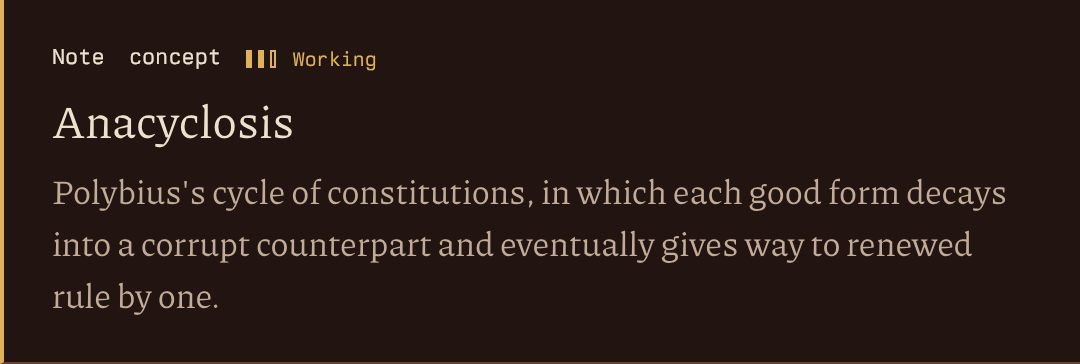
On a wide screen, following a note link brings up a compact card beside the passage. I can keep the sentence that sent me there in view while reading its gloss and key links. Further links replace the card and leave a short breadcrumb trail. The current reference stays in the address. On a phone, the same card docks along the bottom edge and leaves the main text in view above it.
The page gives the sheet room to open out. A margin card holds the gloss and links, not the full note.
Making the note in Tessera
Tessera now provides structure that I used to leave to memory. A position is an attributed claim with a holder and a subject. It can live under a source highlight and still be filed under the concept it concerns. A holder’s page gathers its perspectives; a concept can compare its positions side by side. Source sigla hang beside citing rows.55Gloss and depth: 9677271; source marks: eb0a026, 8d6907f; positions and compare: 64de8af; questions: cda0dbf; constellation: 8383a51. The perspectives design describes the shipped controls and apparatus margin.
Polybius
Such is the cycle of political revolution, the course appointed by nature in which constitutions change, disappear, and finally return to the point from which they started.
W. R. Paton · 1923 · 6.9.10
The cited highlight keeps the source, snapshot and passage.
POL Polybius → Anacyclosis
- Gist
- A cycle by nature, slowed by mixing
- Work
- Histories · 6.9.10
- Shape
- Circle
First link: holder. Second link: subject. Fields remain ordinary children.
Anacyclosis
Perspectives filed elsewhere
POL Polybius
A cycle by nature, slowed by mixing
The concept finds the same position. It does not acquire a copy.
Its gloss and four-stop depth dial let me move from Gloss through Opening and Perspectives to Full. Questions can collect answers and be open, answered, parked or unsettled. A concept with enough perspectives has a constellation in its apparatus margin when the pane is wide enough. I wanted these tools to help me turn reading into my own prose. The primitives behind Tessera traces their interface lineage and the move to attributed positions. The claims, sources and distinctions I make in Tessera should survive publication here.
Anacyclosis
Polybius's cycle of constitutions.
The authored gloss alone.
Anacyclosis
Polybius's cycle of constitutions.
Kingship gives way to tyranny, aristocracy to oligarchy, and democracy to mob rule.
The gloss and text before the first top-level heading.
Anacyclosis
Polybius's cycle of constitutions.
Kingship gives way to tyranny, aristocracy to oligarchy, and democracy to mob rule.
Perspectives
Plato
A line of decline, not a circle
Polybius
A cycle by nature, slowed by mixing
Ibn Khaldun
Dynasties rise and fall over three generations
Shown headings and compact positions. Three of six shown here.
Anacyclosis
Polybius's cycle of constitutions.
Kingship gives way to tyranny, aristocracy to oligarchy, and democracy to mob rule.
Perspectives
Plato
A line of decline, not a circle
Polybius
A cycle by nature, slowed by mixing
Ibn Khaldun
Dynasties rise and fall over three generations
The complete outline, including fields and evidence. Excerpt shown here.
Visibility changes. Block identity and authored text do not.
Tessera’s Compare has since moved toward this site’s sheet. Its Readings tab sets the readings I choose side by side, as the sheet’s columns do. Its Criteria tab sets them against the subject’s criteria, such as shape, engine and exit, and a question that names a criterion follows that row, scoped to the holders it links. That’s how criterion:: and between:: work here. One rule still differs. This sheet shows a question only when the selected values differ; Tessera marks only identical values and leaves differences unmarked. Neither treats different wording as a disagreement in itself.66Subject criteria and the criteria matrix: c92b67d, 11 October; Compare design. The site’s question rule is in its README.
What’s still open
The first question is when a claim should leave its concept note. If several other notes need to call it by name, a claim-titled note may be better than a paragraph inside a large concept. I haven’t settled that rule of thumb. Extracting it should make the argument easier to use without erasing the comparison it came from. Tessera now has a Thesis kind for a claim I hold, stated as the title and argued beneath it, but it has no starting template until I settle how a thesis answers a question.
The second is how to show two kinds of question. Some can be answered once. Others recur, collect dated assessments, or may end in aporia. Both surfaces now have four state labels, but labels alone don’t explain that difference to a reader. In Tessera, an unsettled question can carry a date for its next review, and an answer can record aporia as a dated finding. I still need to decide how a history of assessments should read on this site.77Site question states: 2b11524. Tessera’s domain model distinguishes recurring questions from those settled by an accepted assessment.
What shape does the sequence take?
No accepted assessment yet.
Plato: line
Polybius: circle
A question can gather evidence before an answer is accepted.
Where does Plato's sequence end?
In tyranny. It doesn't return to its beginning.
Republic · bk. 8
Answered follows from the accepted assessment. It is not a separate stored verdict.
How often does the cycle run its full course?
Rarely, for Machiavelli. A weakened state is usually conquered first.
Discourses on Livy · I.2
Pause the question. Resume it before accepting an assessment.
What drives the change between stages?
Polybius traces constitutional forms. Ibn Khaldun traces dynasties and group feeling.
Histories · 6.9.10
Muqaddimah · ch. 3, §12
Compare their shapes first: circle against rise and fall.
Review · 2026-11-06
The current reading can be accepted without closing the inquiry. The earlier one remains readable.
The constellation is a third question. Tessera now draws one, but the site’s sheet doesn’t. An orbit of holders and related notes can help me see what to open next. Some connections need more than a line. I’d like to keep both it and C’s more composable workspace as optional ways into the prose. Tessera’s planned spreads come at C without a canvas: up to five notes side by side, with aligned rows for fields, sources and links, saved as a page with my commentary beneath. They’re designed and not yet built.88Spreads in the domain model; the notes stage lists them as remaining.
I can now hover for a sentence, open a note beside another, and compare two attributed accounts on a real page.
Footnotes
-
The site reading sheet landed in
2d6eb35, followed by sigla and hidden empty assessments in854ff48, 6 October. Tessera’s glosses and positions landed in9677271and64de8afthat day. ↩ -
The site’s README documents selection, compare addresses, passages and the stacked reading without JavaScript; the renderer builds the sheet from the Markdown. ↩
-
The 6 October shared contract and three topic-web mockups are saved with the design study. The excerpt comes from the anacyclosis note’s own source file. The contract describes the intended export, not a shipped exporter. ↩
-
Typed notes replaced the separate glossary and lenses in
0d3a9a0, 6 October. ↩ -
Gloss and depth: 9677271; source marks:
eb0a026,8d6907f; positions and compare: 64de8af; questions:cda0dbf; constellation: 8383a51. The perspectives design describes the shipped controls and apparatus margin. ↩ -
Subject criteria and the criteria matrix: c92b67d, 11 October; Compare design. The site’s question rule is in its README. ↩
-
Site question states:
2b11524. Tessera’s domain model distinguishes recurring questions from those settled by an accepted assessment. ↩ -
Spreads in the domain model; the notes stage lists them as remaining. ↩
References
- Ahrens, Sönke. 2017. How to Take Smart Notes. CreateSpace.
- Ibn Khaldun. 1958. The Muqaddimah: An Introduction to History. Translated by Franz Rosenthal. 3 vols. Bollingen Series 43. Pantheon Books.
- Martin, Robert Andrew. 2022. “Molecular Notes: Principles.” Reasonable Deviations, April 18. https://reasonabledeviations.com/2022/04/18/molecular-notes-part-1/.
- Matuschak, Andy. n.d. “Evergreen Notes Should Be Concept-Oriented.” Andy’s Working Notes. Accessed October 6, 2026. https://notes.andymatuschak.org/Evergreen_notes_should_be_concept-oriented.
- Plato. 1992. Republic. Translated by G. M. A. Grube. Hackett.
- Polybius. 2011. The Histories, Volume III: Books 5–8. Translated by W. R. Paton. Loeb Classical Library 138. Harvard University Press.
Linked from · 4
TesseraProject
…behind Tessera traces how trails, outlines, fields, cited passages and layered reading led to attributed positions on one subject. Multiperspectival notes covers the reading design shared with this site. Still ahead are the capture stage's browser extension, feeds, newsletters and book…
The primitives behind TesseraInvestigation
…supporting passages and a question still under consideration. These should stay distinct and readable together. That's the note format in Multiperspectival notes.
AnacyclosisNote · Concept
Multiperspectival notes uses anacyclosis as its worked example of a concept note that keeps several sources' views together.
ZettelkastenNote · Concept
Evergreen notes and Molecular notes describe related approaches to linked writing. Multiperspectival notes considers how a concept note can gather different sources' treatments of the same idea.