Investigation
How Umran's interface took shapeA first-month history of Umran's screens, from a terminal language generator to an inked chart, an overlaid book, and two views of one spherical world.
vn481vmyx0 · Working
Read full investigationUmran/ investigation
How Umran's interface took shape
A first-month history of Umran's screens, from a terminal language generator to an inked chart, an overlaid book, and two views of one spherical world.
- Kind
- Investigation
- Permanent uid
- vn481vmyx0
- Drawn
- Approved
- Pending
- Graph / sources
- 1 in · 2 out / 0 sources
- State
- working
I am building Umran, a world simulator in which peoples settle, split, trade, and conquer, and their languages change through that history. A word can change its sounds, pass to another people, acquire a meaning, or disappear. The interface has to let me read the words and the world that produced them together.
This is a record of how its screens changed between 6 September and 6 October 2026. I worked with coding agents, trying layouts in the browser, discussing what felt wrong, and handing implementation to separate lanes. The evidence here is the commit history, screenshots kept with the repository, and those working sessions. The wireframes are redrawings, not original design files. The archived screenshots show the recorded screens; the flipbook also includes one separately labeled retrospective render of the September workbench.11Git dates use Pacific time, UTC−07:00. Screenshot commits identify recorded states, not first implementations. The September workbench was rendered from 44a6c3e on 6 October, in its default initial state.
Pacific commit time. Lane assignments follow message subject, then touched paths, not agent ownership. Marks share their true horizontal time; small vertical offsets separate clusters. The blank interval is visibly compressed. On a narrow screen, scroll the register horizontally.
From a language to a world
Umran began as a side tool for another project. Underlord was an isometric RPG I built as a proof of concept when Astra came out, and it is shelved for now. I wanted the names of its dark elves, kuo-toa and other peoples to sound like they came from real languages, and it seemed wiser to build a toolkit for making those languages than to keep inventing names by hand.
On 6 September I started that toolkit. The first interface was a terminal application: choose an aesthetic, choose a seed, inspect sounds and words. Within that session I was already asking for evolution, families, and contact. A generated vocabulary was only the beginning of the thing I wanted to explore.
The terminal version acquired a journey through language history, but its checkpoints and controls took up too much of the available space. I asked to try a browser version the same day. That became a workbench for communities, words, and their histories. It was not yet the book-and-map interface shown later in this account.226 September: 5b7213a, 3ec3404, 44a6c3e. Chronicle: a22f169, 30 September. Book spread: 2e0e7ef, 1 October.
The toolkit paused when I wrapped Underlord up as a proof of concept. The models still aren’t quite capable of what I want on a $200 budget, and I didn’t know what I was doing with animations, which were taking forever. The game worked as a prototype, but I didn’t want to pay for Unity. When I came back to the language tool at the end of September, I decided to expand it into a full toolkit; it is still not there, but it is getting there. The browser adopted a chronicle and then a two-page book. On the morning of 1 October the chronicle occupied one page and the language’s words, sounds, and kin occupied the other, with a timeline beneath. The book gave the history a reading order, but there was still little geography to inspect.
That morning I asked for a more detailed world simulator around the languages, one I could step into at any point in its history. I described setting initial conditions, letting the history run, and returning to an earlier point to try a different choice. The map would have to show where the histories diverged, not simply decorate the vocabulary.
The map arrives
The first map settled peoples on seeded regions. Contacts could depend on neighboring land, and a split could put its departing people somewhere. Geography showed where speakers lived, who could meet, and which lands a language reached.
By the screenshot saved in 003e2d1, the map had become the stage. A dark field of polygonal regions filled the left side. The right column held the world’s card, counts, and a long roster of peoples and languages. A live chronicle feed floated over the map’s lower-left corner. Along the bottom, Play and other controls surrounded a slider with event diamonds above it.33Atlas: dd812f5; stage: b1e0302. Documentation commit 003e2d1 saved the reproduced screenshot on 1 October.
This arrangement put place, the current subject, and time on one screen. It also made their competition visible. The feed covered part of the map. The sidebar had to contain both short facts and material that wanted the width of a page. The controls still belonged to a simulation being watched as it ran.
The six plates trace the stage’s arrangements, leaving out world-specific names and fine cartography to show the divisions of space.
The first stage
2026-10-01 · 11:47 · 003e2d1
- Brand, Export, title and Look
- World card, counts and peoples
- Floating chronicle feed
- Play, pace, event diamonds and actions
A folio over the chart
2026-10-01 · 16:25 · caa294f
- Chart retained beneath the folio
- World reading card at right
- Long section in an overlaid folio
- Latest chronicle line
- Transport and timeline below
Open-folio reconstruction. The caa294f capture shows the right card, not an open folio. This plate applies the surviving 6bda82d chronicle folio’s margins to that earlier stage.
The living atlas
2026-10-01 · 23:03 · 6bda82d
- Brand, title, atlas index and light
- Layers, chart and in-map zoom
- World and Chronicle reading card
- Chronicle line above transport
The chart takes the stage
2026-10-02 · 08:42 · ea2746c
- World cartouche and menu
- Find, Layers and in-map zoom
- Actions on the world card
- Caption on the chart’s lower edge
- One time row and drawn timeline
The book of a world
2026-10-02 · 11:35 · 499f92d
- World, telling and year
- World account, specimen and Run
- Latest sentence beside Chronicle
- Run to a year, Study and timeline
The same stage, a globe
2026-10-06 · 00:37 · 03e1c9b
- Orthographic globe, same regions
- Chart and Globe projection switch
- Pinned place gazetteer
- World account beside the globe
- Caption and drawn time row persist
The explorer’s chart
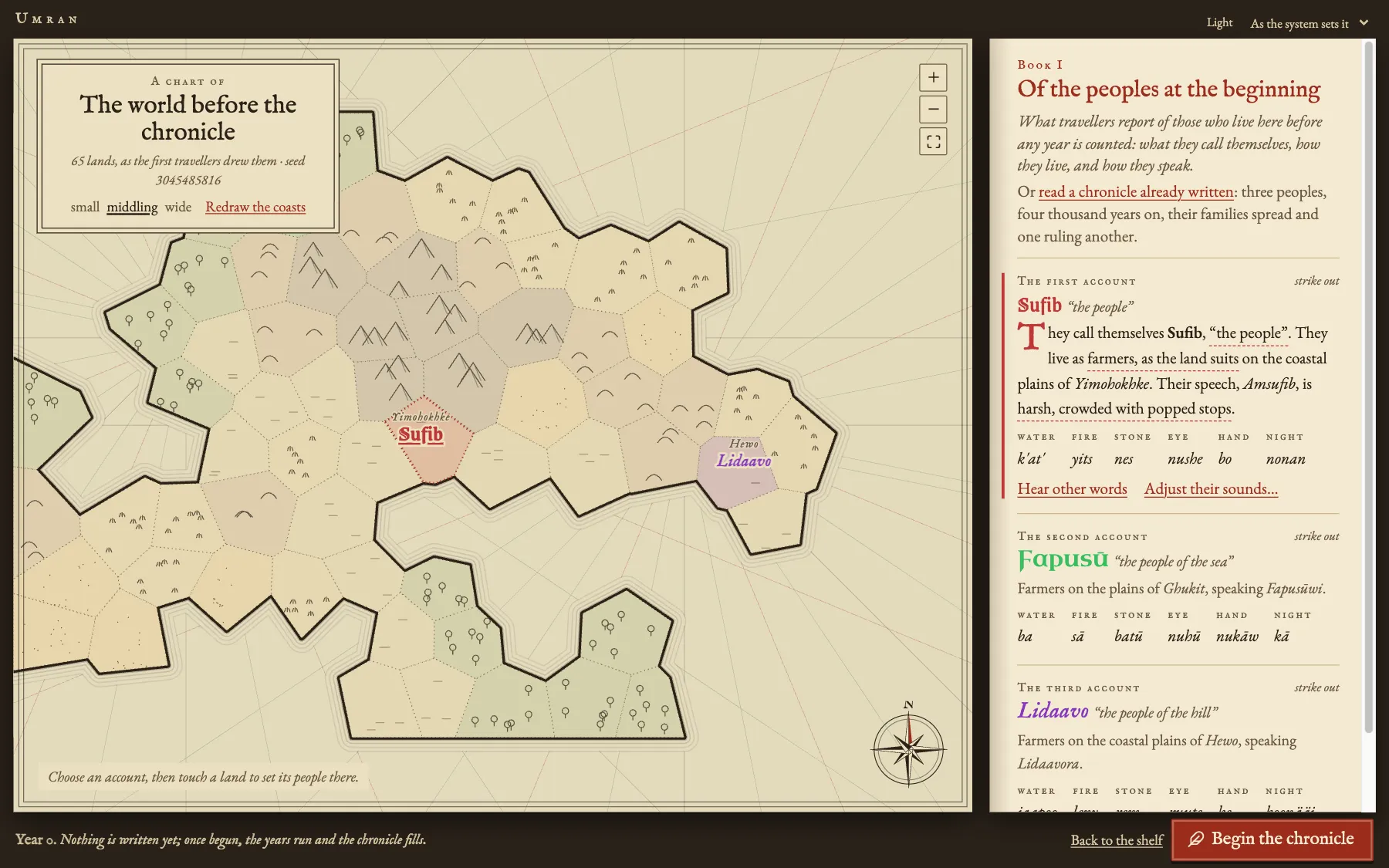
Later on 1 October I asked to walk through the initial setup screen. It was still a plain library of cards, and I wanted the first thing a person saw to feel like the world it opened onto. The new name, Umran, had suggested a historian charting distant civilizations. I wanted to try that visual direction before deciding how much of it belonged in the application.
The agent made a clickable chart mock using the running world’s map shapes. It added paper, an inked coast, offshore ripple lines, compass lines, terrain drawings, and a framed title box. Beside the chart, an account described a people through clickable phrases rather than a stack of generic dropdowns. A small specimen kept real words in view while choices changed.
The distinction between the mock and the engine mattered. Some of the mock’s sea labels and sound descriptions were invented for the presentation. I am not treating those as features of the world model. What carried into the application was the arrangement and cartographic vocabulary: a chart to inspect, with accounts beside it.44The agent’s notes from that evening mark which of the mock’s details were placeholders.
The change shipped as 67bde57. The old Workshop and Scriptorium looks were removed rather than kept as alternatives. Day and lamplight remained two ways to read the same chart. Setup now had a book of founding accounts and a quieter link to the sample chronicle.
Identity and installation followed alongside this work. The astrolabe mark and the lettering ʿUmrān gave the application its own title; the progressive web app work made it installable and usable offline. Those changes did not determine the stage layout, but they belong to the same short stretch of its history.55Chart: 67bde57; offline app: 0b9ddb8; astrolabe: 4e2c9d5, all 1 October. Custom installation notices were removed in e4b823c.
Folio over the map
The right-hand column was soon too narrow for what the model could tell. Short facts and a specimen fitted it; dictionaries, cognate tables, family trees, and long dealings did not. In portrait, the map and card stacked, the floating feed covered much of the chart, and the time controls wrapped. My complaint was about the arrangement as much as the amount of information.
The proposed split was a quick card for immediate context and a wider folio for long reading. We compared placing that folio beside the map with laying it over the map. I asked for a mock because I did not want to give up the map while reading. Once the clickable version was visible, the choice was easy: over the map.66Two-option mock on 1 October; implementation: caa294f.
The selected arrangement left the chart under the reading sheet, visible around its edges. Closing the sheet returned to the same stage. The sidebar remained a quick card, while long sections gained room for tables or prose.
An overlaid page hides much of the geography while open. It preserves the chart as the place one returns to, rather than keeping every region readable. The folio commit, caa294f, records that choice in the interface and a new screenshot.
The chart takes the whole stage
The next stage pass removed the full-width header. Its contents were redistributed instead of being replaced with another toolbar. The world name, telling, and year went into a cartouche at the chart’s upper-left corner. World-level navigation and export moved into its menu. Find and Layers went to the upper right; zoom remained on the map.
The floating chronicle became a caption along the chart’s foot. The bottom controls became one compact time row. Turning points acquired different shapes on a drawn timeline, with sound changes on a quieter track and a ruler below. Popovers held choices that previously occupied permanent controls. Actions began moving onto the cards of the things they acted on.77615d88a and ea2746c, 2 October. Before screenshot: 6bda82d, 1 October.
Before
2026-10-01 · 23:03 · 6bda82d
After
2026-10-02 · 08:42 · ea2746c
- World titleTop-left cartouche
- Export and light in the headerWorld menu in the cartouche
- Atlas index in the headerFind at the map’s top-right
- Chronicle line in the footerCaption over the map’s lower edge
- Transport and event ticksOne time row, drawn turning points
- Shape history menuVerbs on the world card
The latest chronicle line had already moved out of the floating feed by the “before” capture. Here it leaves the two-tier footer and becomes a caption inside the map. Menus become popovers; map zoom stays in the map. On a narrow screen, scroll the diagram horizontally; its route key stays below.
By ea2746c, the chart reached the top edge of the stage. This did not eliminate the right-hand card. It removed the strip above the chart and reduced the competing structures below it.
Later on 2 October, I stepped back from the accumulating features. What I wanted was a toolkit for building histories on the scale of those behind Tolkien’s languages. The live simulation had begun to dominate a tool intended to produce languages and cultures. The product document and 499f92d reorganized it around four screens: chart room, founding, workshop, and book.88Product frame: docs/book.md, 04ce2c5; implementation: 499f92d.
Running to a chosen year became the main time action; play and step remained available for study. The book collected lands, peoples, languages, and the chronicle into chapters, laid over the chart. The older book metaphor returned, now with a world beneath it.
The chronicle in eras
The chronicle had a different space problem. A flat list gave routine annual bookkeeping roughly the same visual weight as a conquest or the rise of a state. Making the list smaller would fit more entries without saying which ones mattered to the history.
On 2 October the chronicle became a contents page of eras. An era had a span and an opening headline, with a compact account of the peoples, states, and languages it concerned. In the reading sheet, an era header stayed visible while its entries passed beneath it. Headline entries stood out; quieter records folded beneath their year.99Era direction: 19158a9; implementation: 788353e; apparatus scale: cc638be, 2 October. See docs/book.md.
A flat log
6bda82d · 2026-10-01
A chronicle in eras
788353e · 2026-10-02
Selected era spans and row categories, not a replay of one world. The header stays with the era while its entries scroll; search and filters can unfold the quieter rows.
The quiet entries were still there. Searching or filtering unfolded matching material, so the hierarchy did not make a sound change inaccessible when that was the subject of the reading. The stage caption could also favor a same-year headline over routine accounting.
A separate density pass reduced apparatus such as rosters and facts while keeping specimen words and prose at their reading scale. The cards needed compact ways to find something and room to read it. These changes shipped as 788353e and cc638be.
Founding, from form to accounts to place
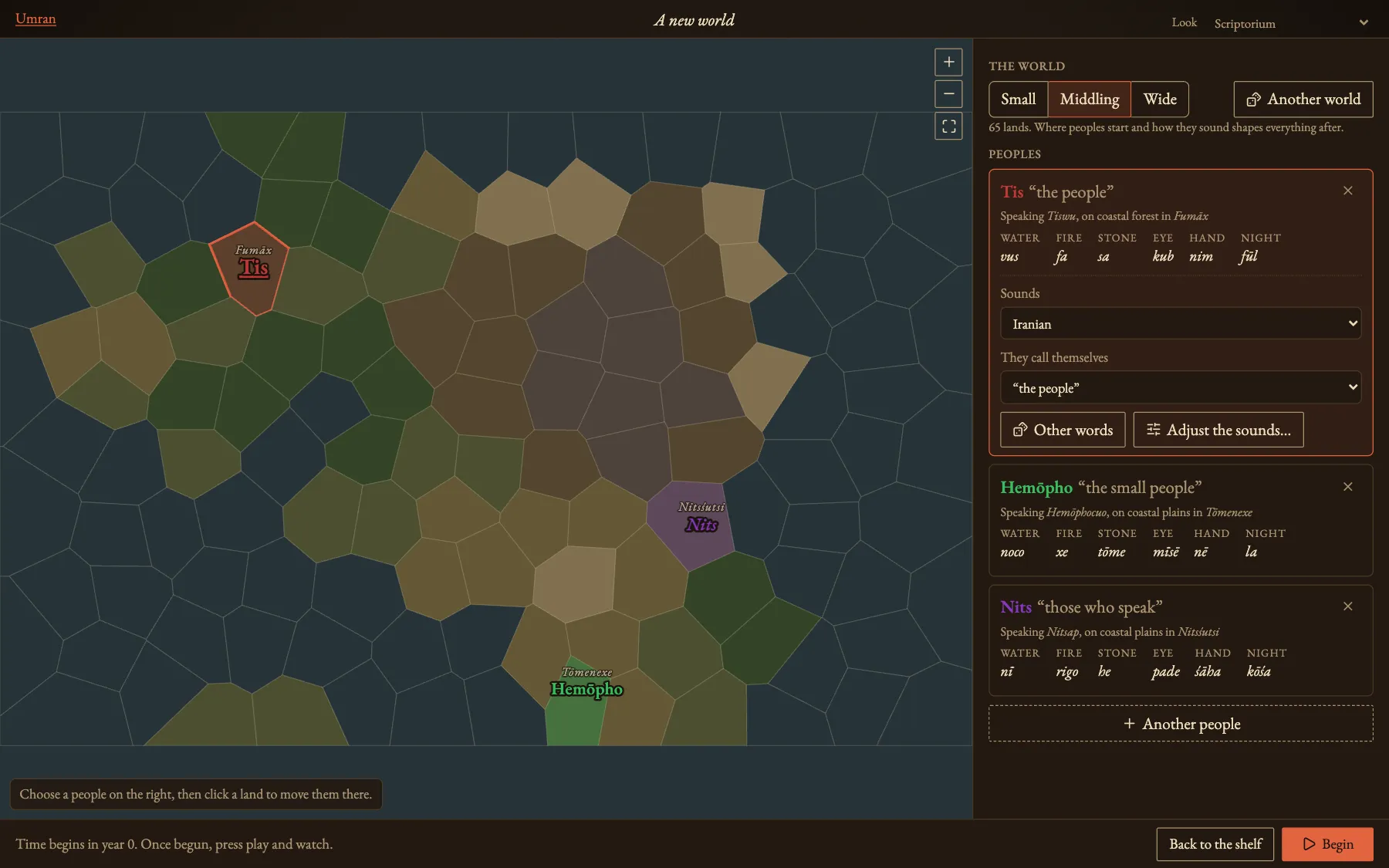
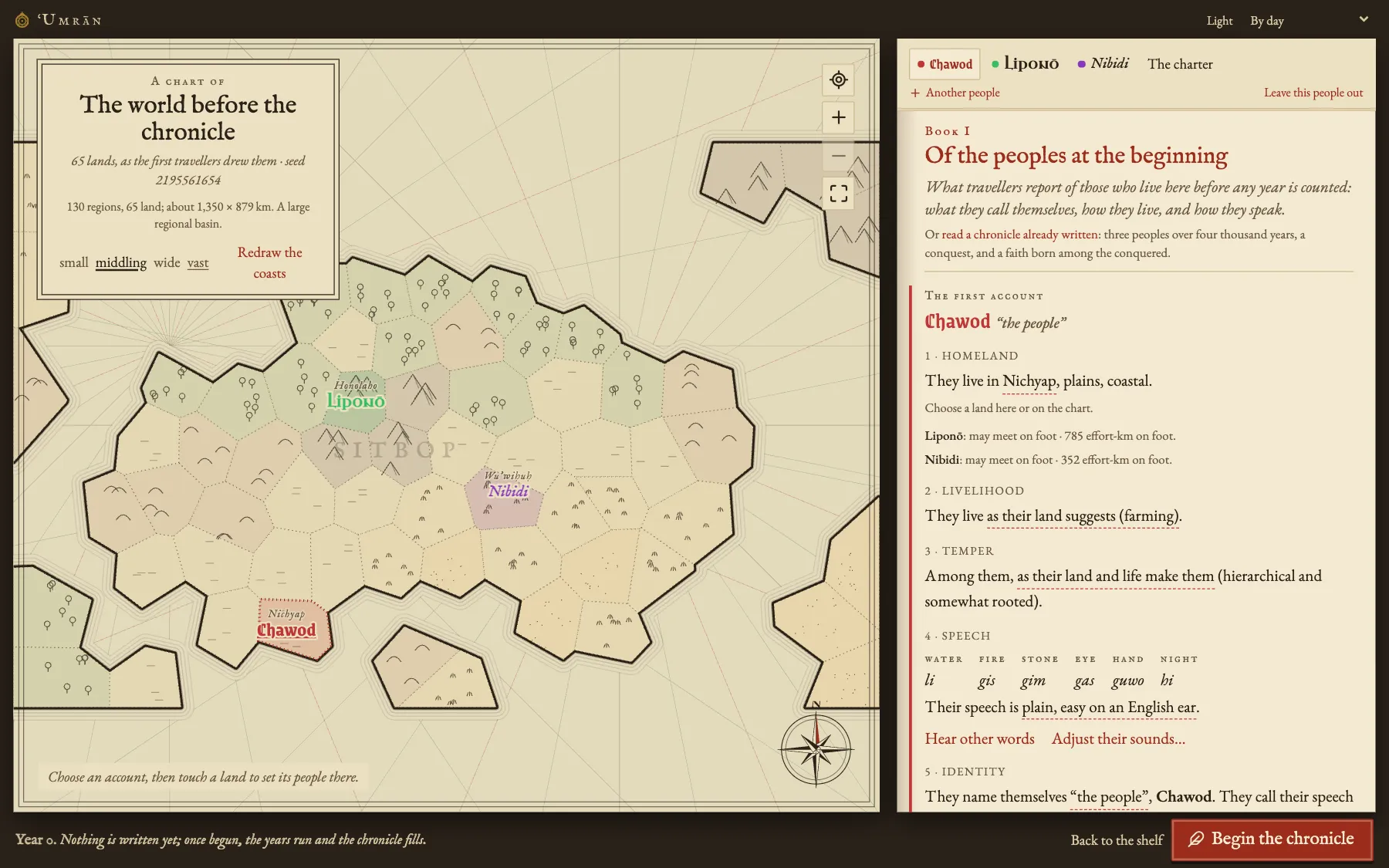
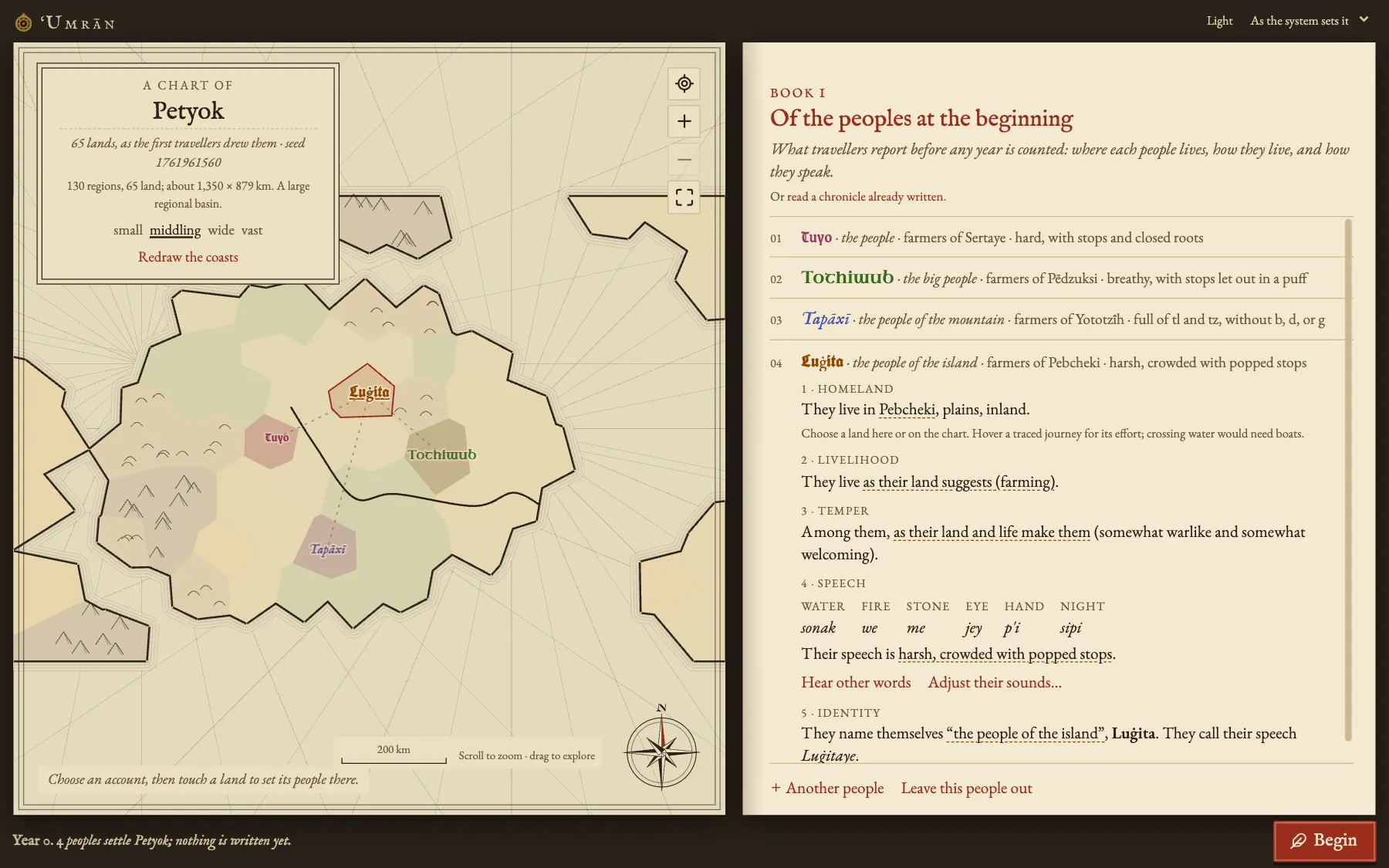
Founding changed several times without abandoning the chart-and-account pairing. In the earliest saved setup, the right panel was a form for choosing peoples. The explorer-chart pass turned those choices into prose accounts. The guided founding pass made the account more explicit: Homeland, Livelihood, Temper, Speech, and Identity, followed by a charter comparing the founders.1010Accounts: 0c833f2. Later contracts: docs/book.md and docs/history.md. Click-to-move: e4cfcea, after the final setup screenshot in 5d5be5e.
Those five sections were visible in one account, rather than successive steps in a wizard. The map showed the homeland, and a specimen showed what the speech choices actually produced. The charter offered a way to review the starting conditions together. It did not need to become another gate before beginning the history.
A form beside the map
003e2d1
 Open full frame ↗
Chart and notebook
67bde57
 Open full frame ↗
Accounts and charter
0c833f2
 Open full frame ↗
Accounts as a contents list
499f92d
 Open full frame ↗
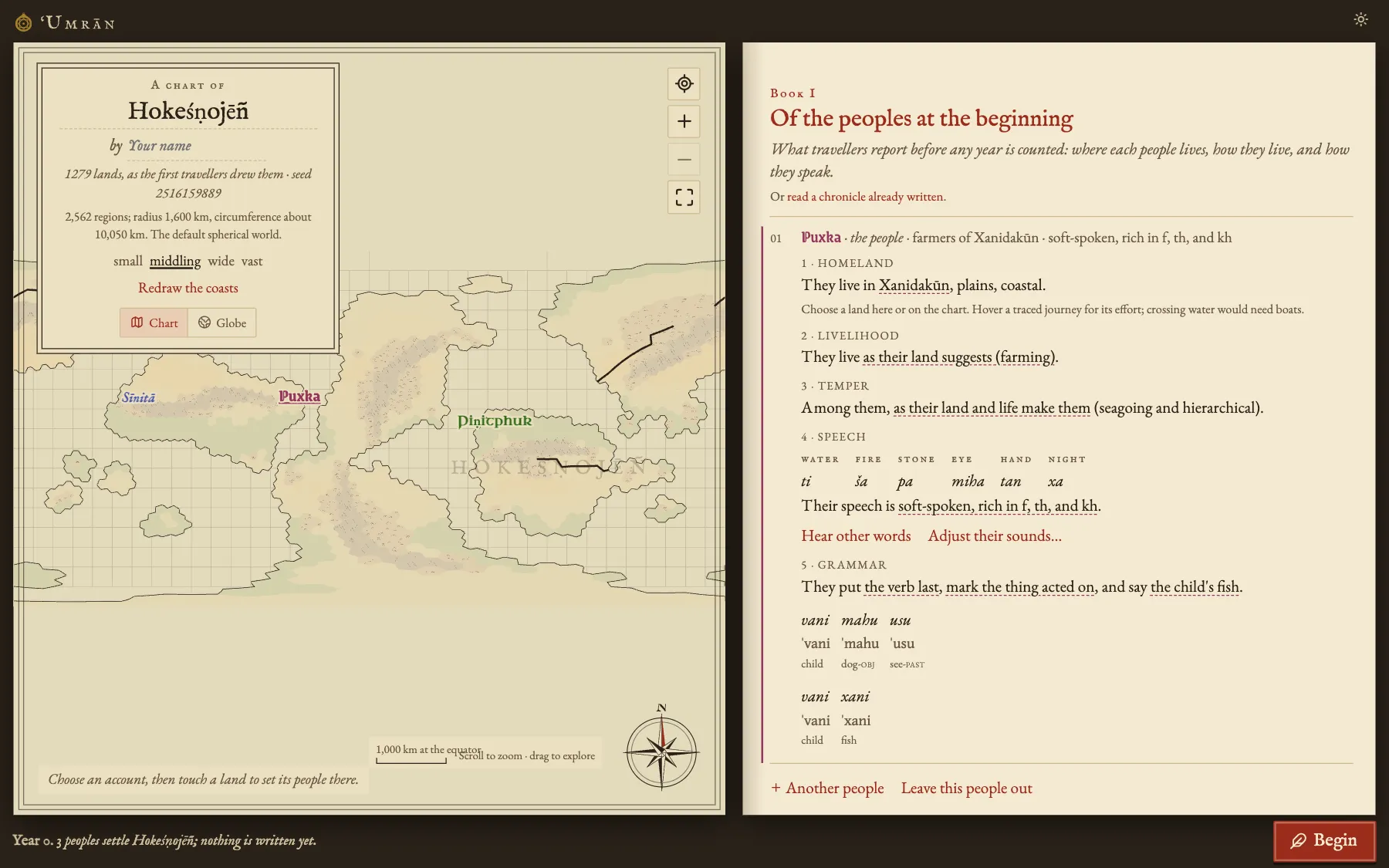
One sphere, two projections
6349888
 Open full frame ↗
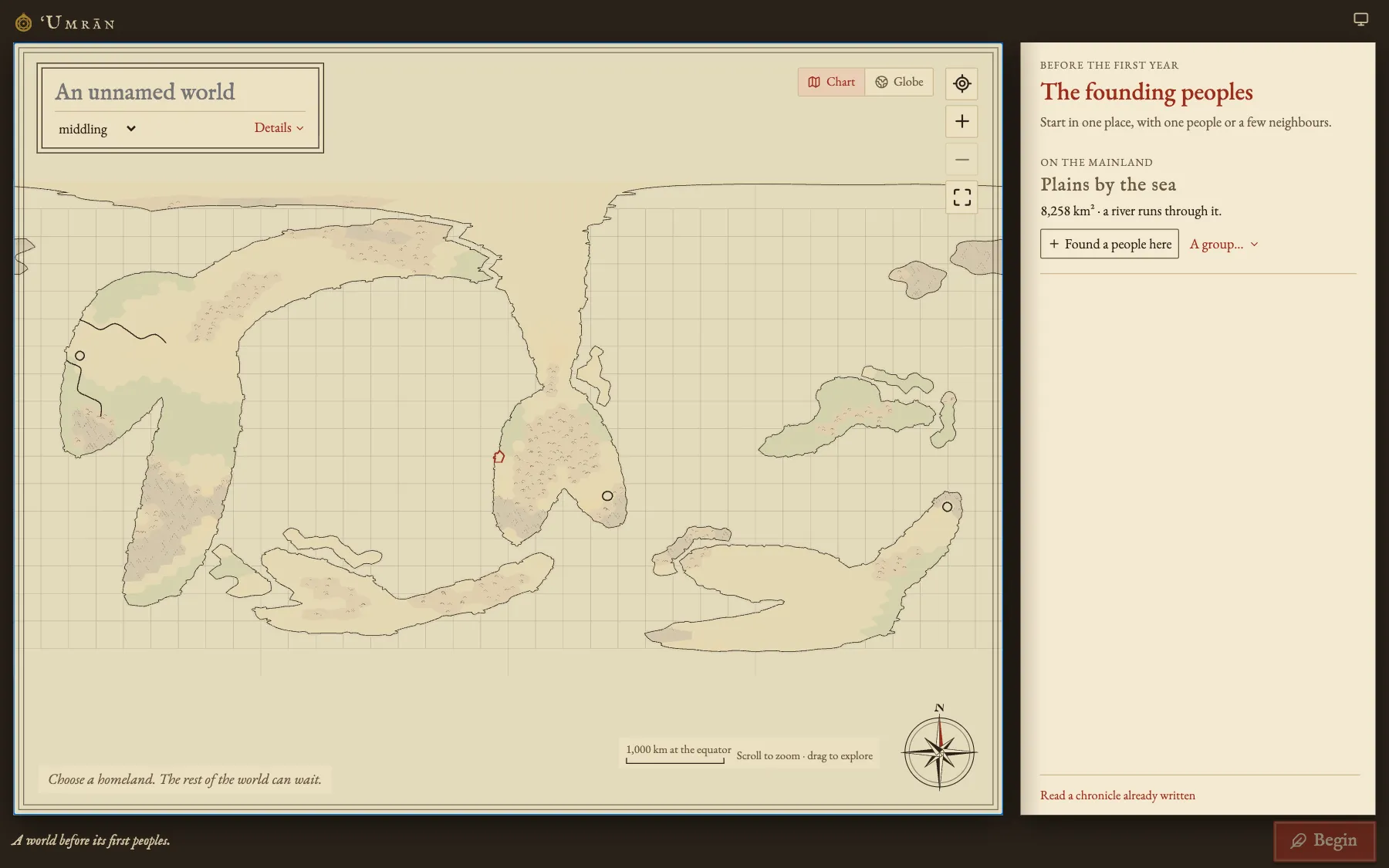
Choose a homeland first
dd9927c
 Open full frame ↗
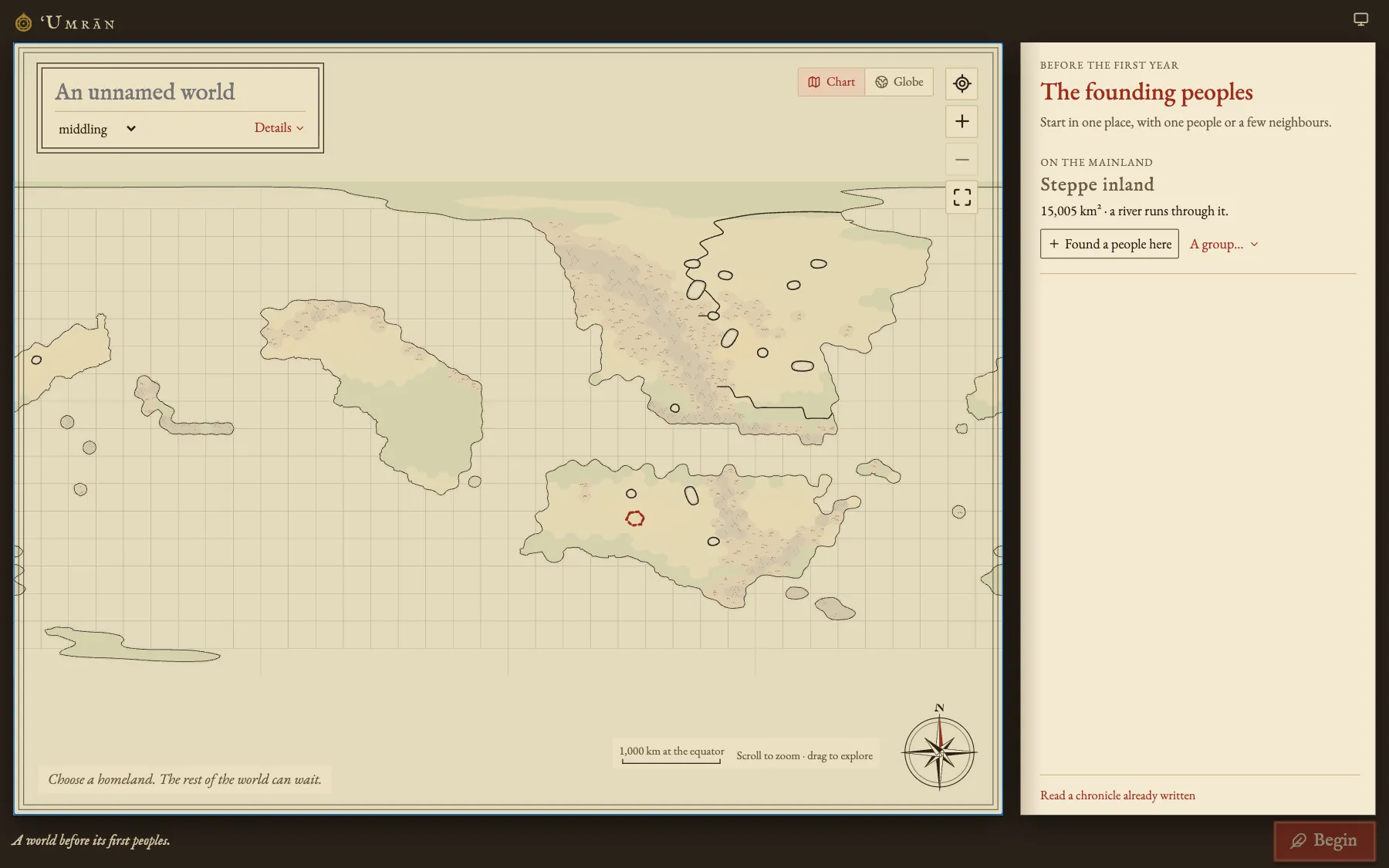
Place-led founding
9cdeb0d
 Open full frame ↗
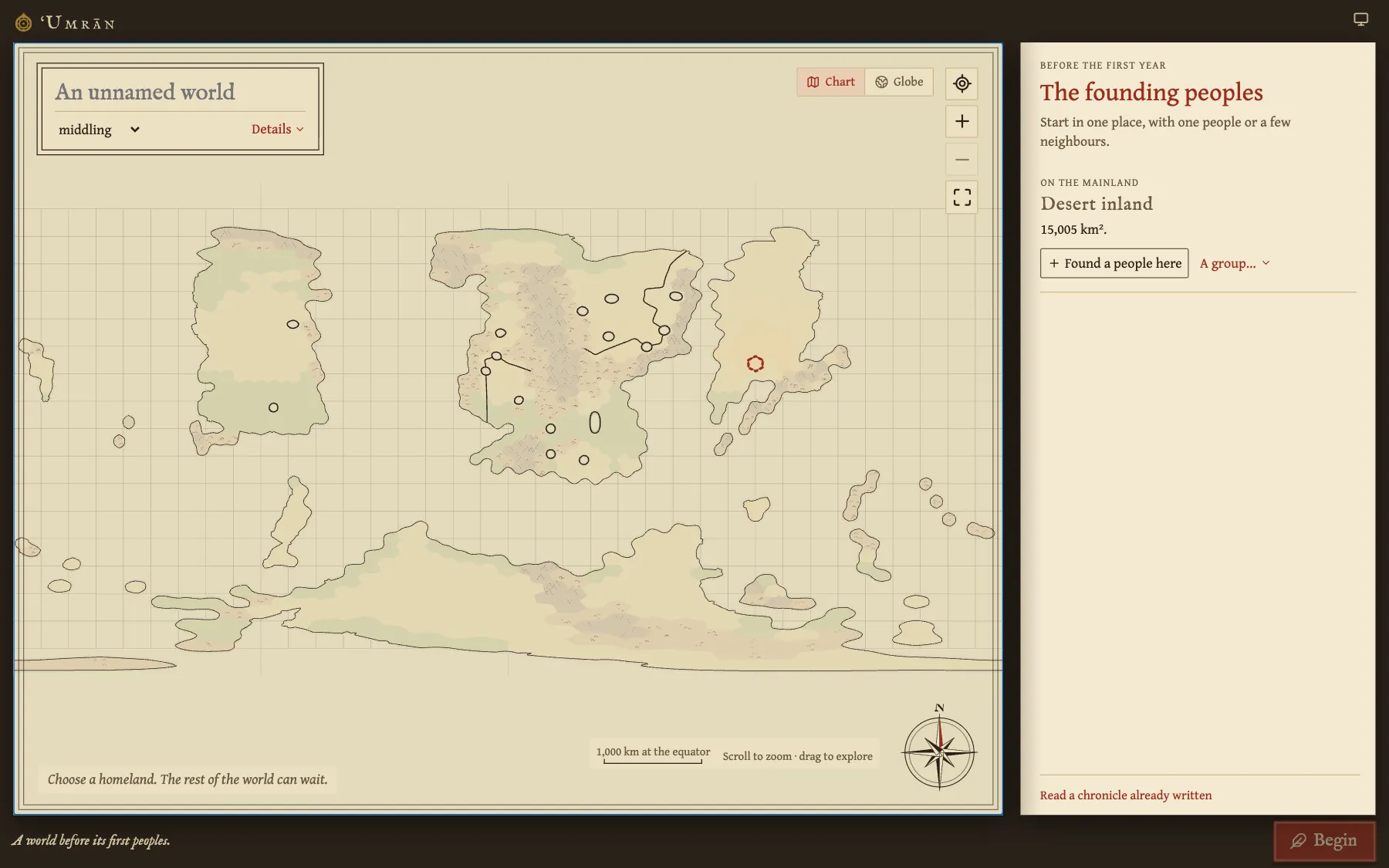
The place-led screen, relettered
5d5be5e
 Open full frame ↗
Archived screenshots, in Pacific commit time. Open any image to read the original frame at full size. The 0c833f2 account exposes Homeland, Livelihood, Temper, Speech and Identity; later states change both the map and the way founding begins.
The later direction began with an unpopulated world. Selecting a land inspected it; founding a people there was a separate action. The roster stayed visible while one people’s portrait could scroll. Homeland, livelihood, temper, and a word specimen stayed close together, while grammar, naming, and the full sound chart could open when needed.
Inspection and relocation became separate actions: looking at another land should not silently move an existing people. Nearby groups and related groups became different choices, since proximity is not shared linguistic ancestry. The final October passes improved spacing between founding peoples and made moving them an explicit click operation.
A sphere, read as a chart or a globe
On 3 October the world became spherical. I had raised the possibility of full globes while worrying about losing the earlier cartographic direction. The resolution separated the underlying geography from the surface used to read it.
The engine’s regions now belonged to a closed sphere built from a subdivided icosahedron. Distances and areas were measured there. The inked chart remained the default view; an orthographic globe offered a second projection. Lands, rivers, journeys, cards, and founding placement referred to the same world in either view.1111Sphere: 6349888, 3 October; gazetteer: dd9927c, 4 October; plate drift: fbbb78c, 5 October; final screenshot: 03e1c9b, 6 October. See README.md, docs/engine.md, docs/history.md.
A coarse projection schematic, not Umran’s terrain. The app’s icosphere has many more regions. Changing the reading does not change the world.
Switching projection was a reading choice, not an event in the world’s history. The world did not become round as time advanced. An early suggestion of a flat-to-round mythic transition remained a discussion, not the implementation described here.
On 4 October, place inspection brought names in different languages into a gazetteer over the map. On 5 October, new worlds began using a short plate-drift history to draw more varied continents. The last recorded stage screenshot, from 6 October, incorporates later lake and label work. These changes enriched the chart’s contents while keeping the cartouche, map tools, caption, and time row recognizable.
What held
Scrubbing the screenshot sequence shows how much of the arrangement survived while the geography, type, and cards changed.
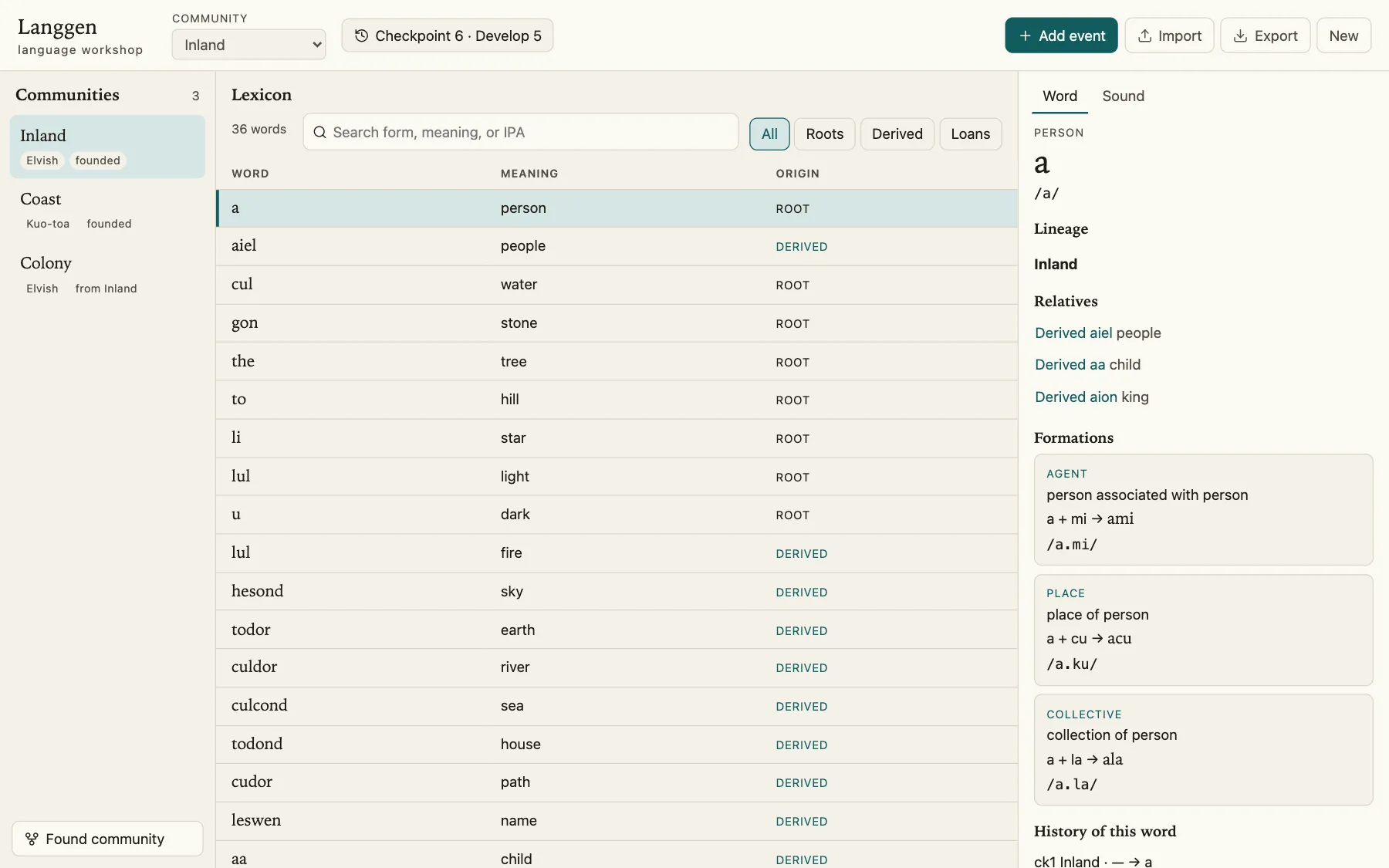
feat: move language history into a browser workbench
Retrospective render. The 09-06 workbench at 44a6c3e, built and captured on 2026-10-06 in headless Chromium at 1440 × 900. This is not an archived screenshot.
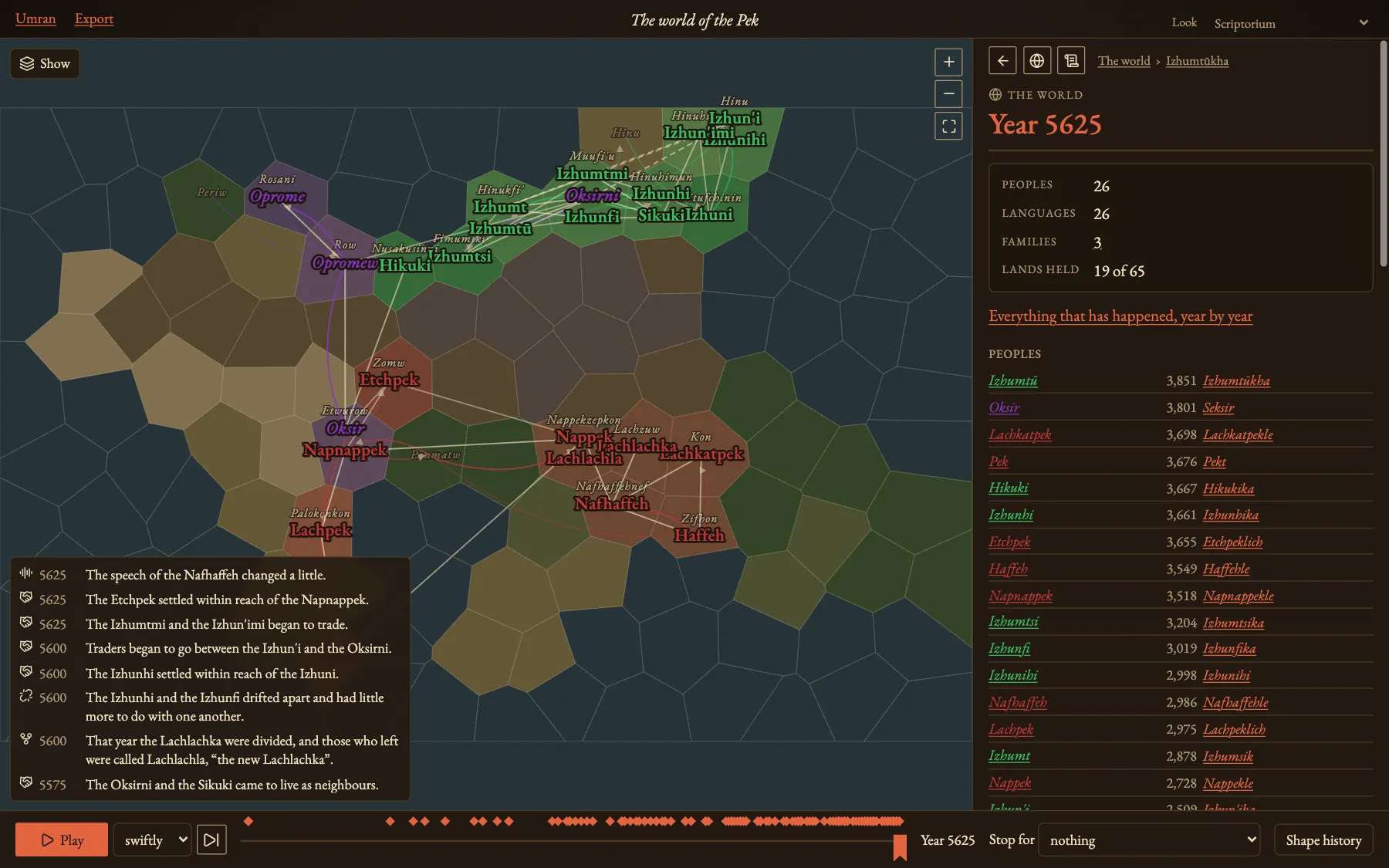
docs: add a README, license, and GitHub workflows
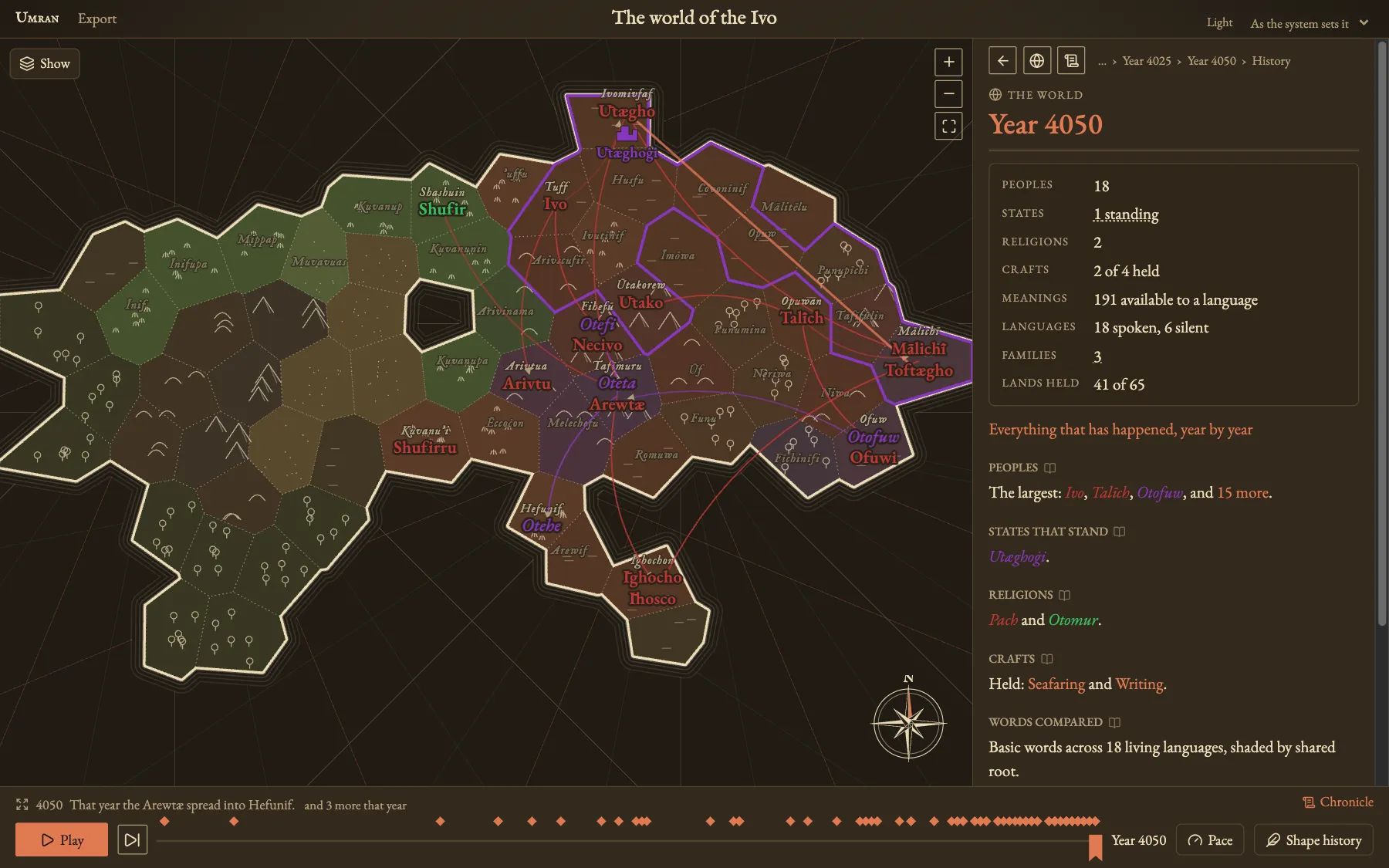
feat(web): open long card sections in a folio over the map
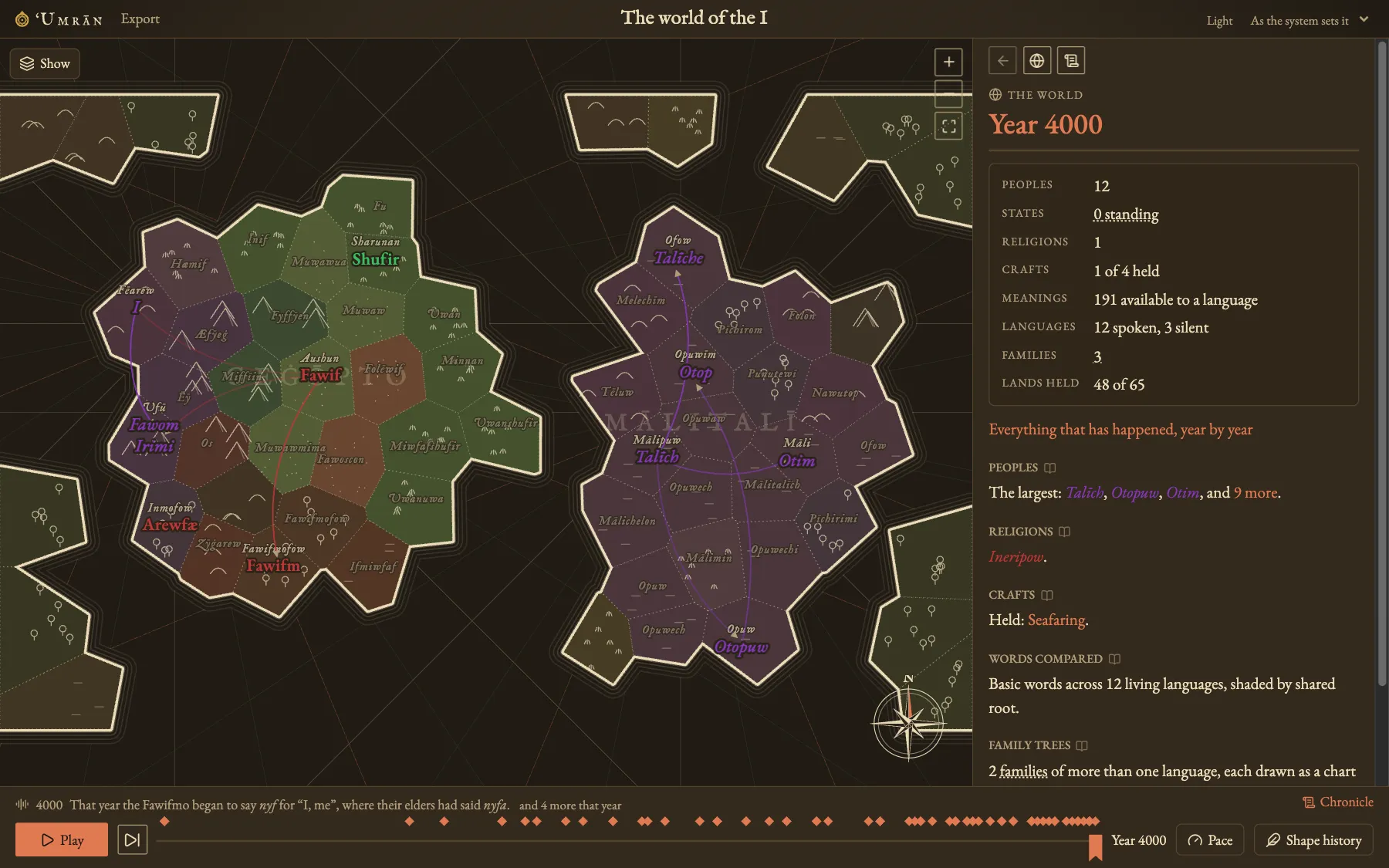
feat(web): letter continents on the chart and show what peoples know
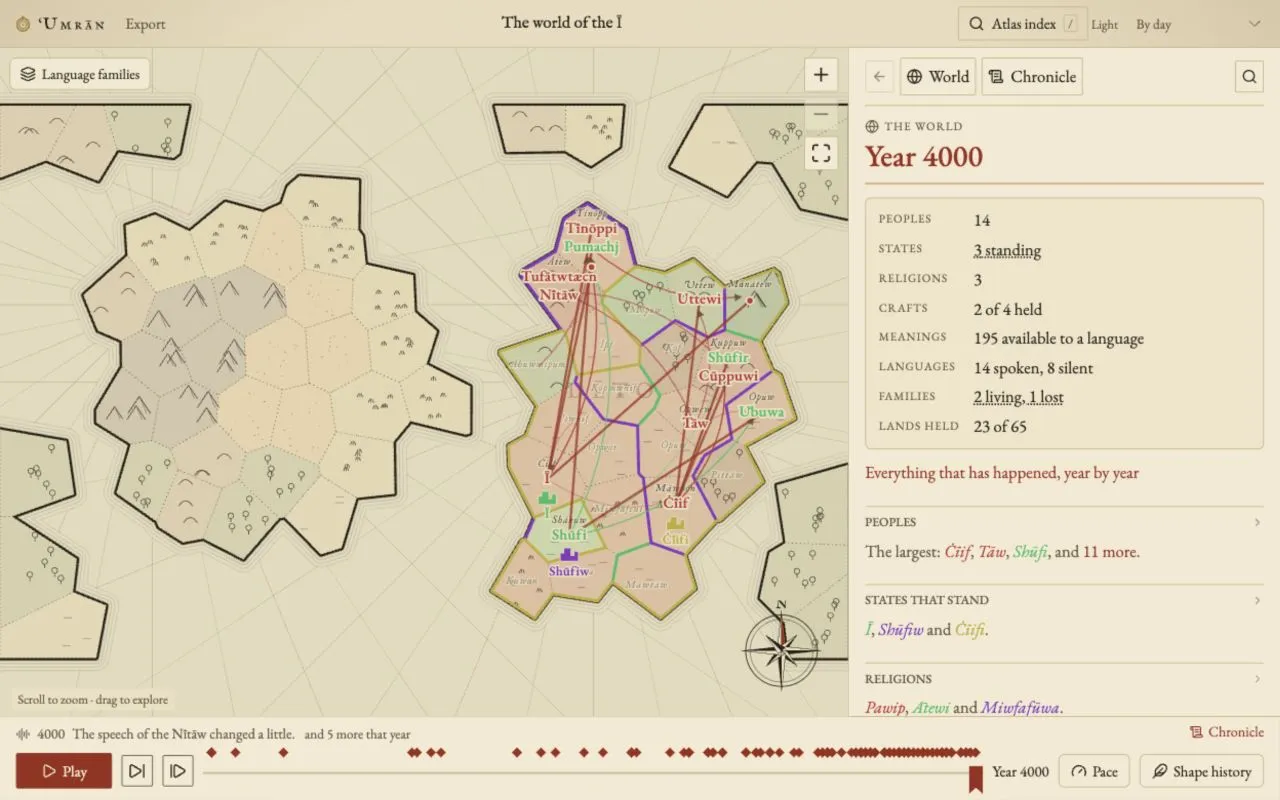
feat(web): make the atlas and chronicle easier to explore
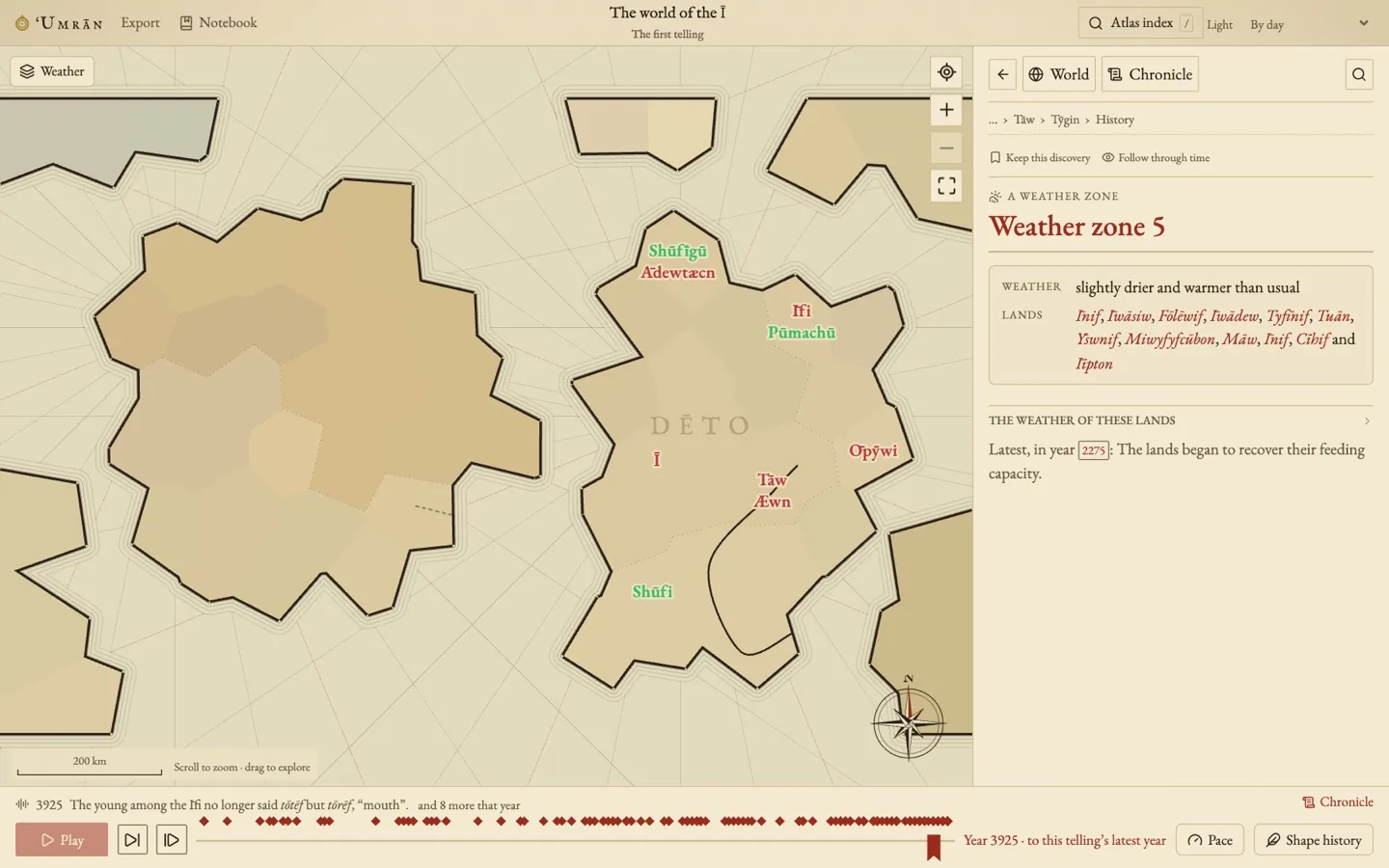
feat(web): chart rivers, weather and scale on the map
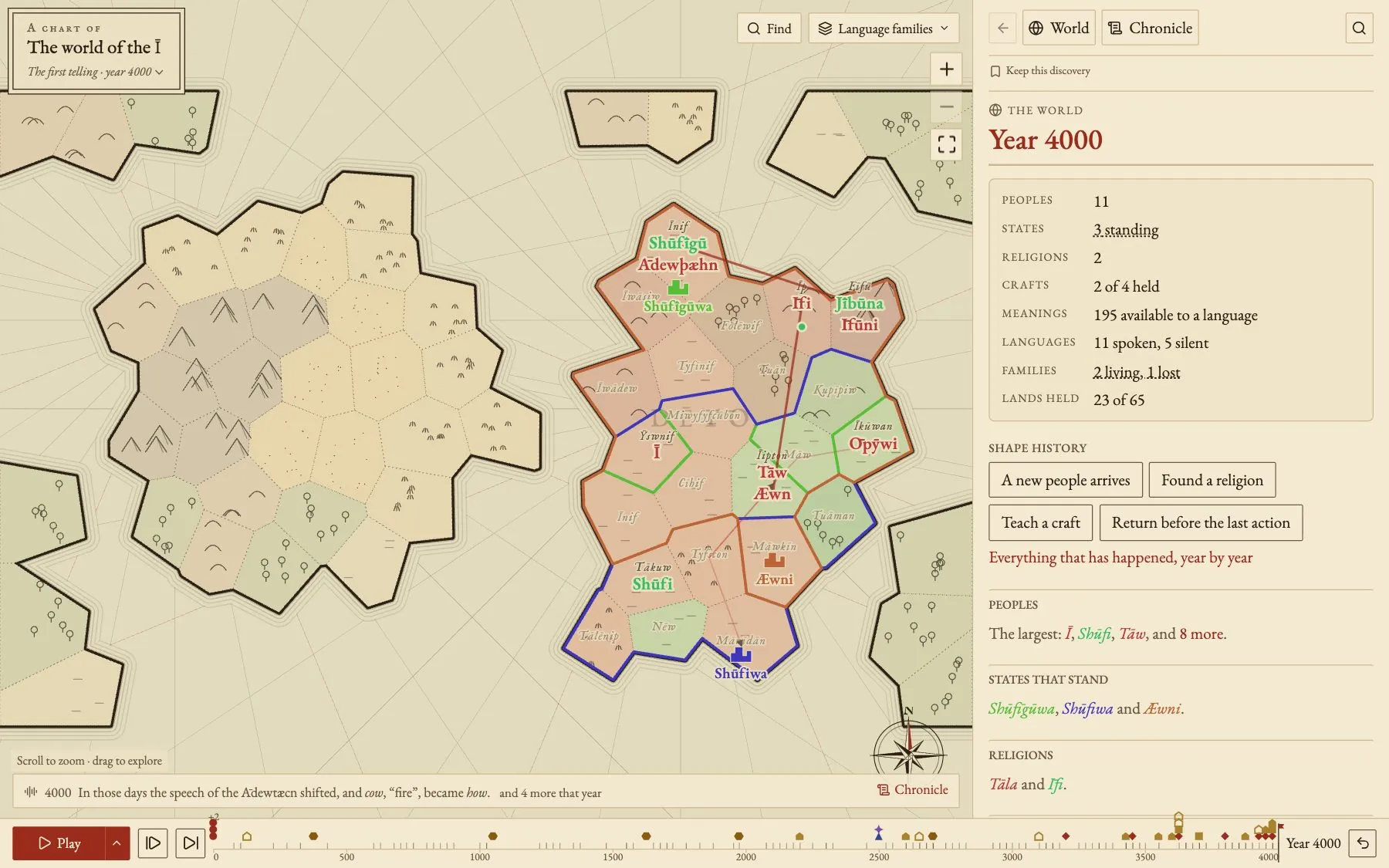
feat(web): give the chart the whole stage
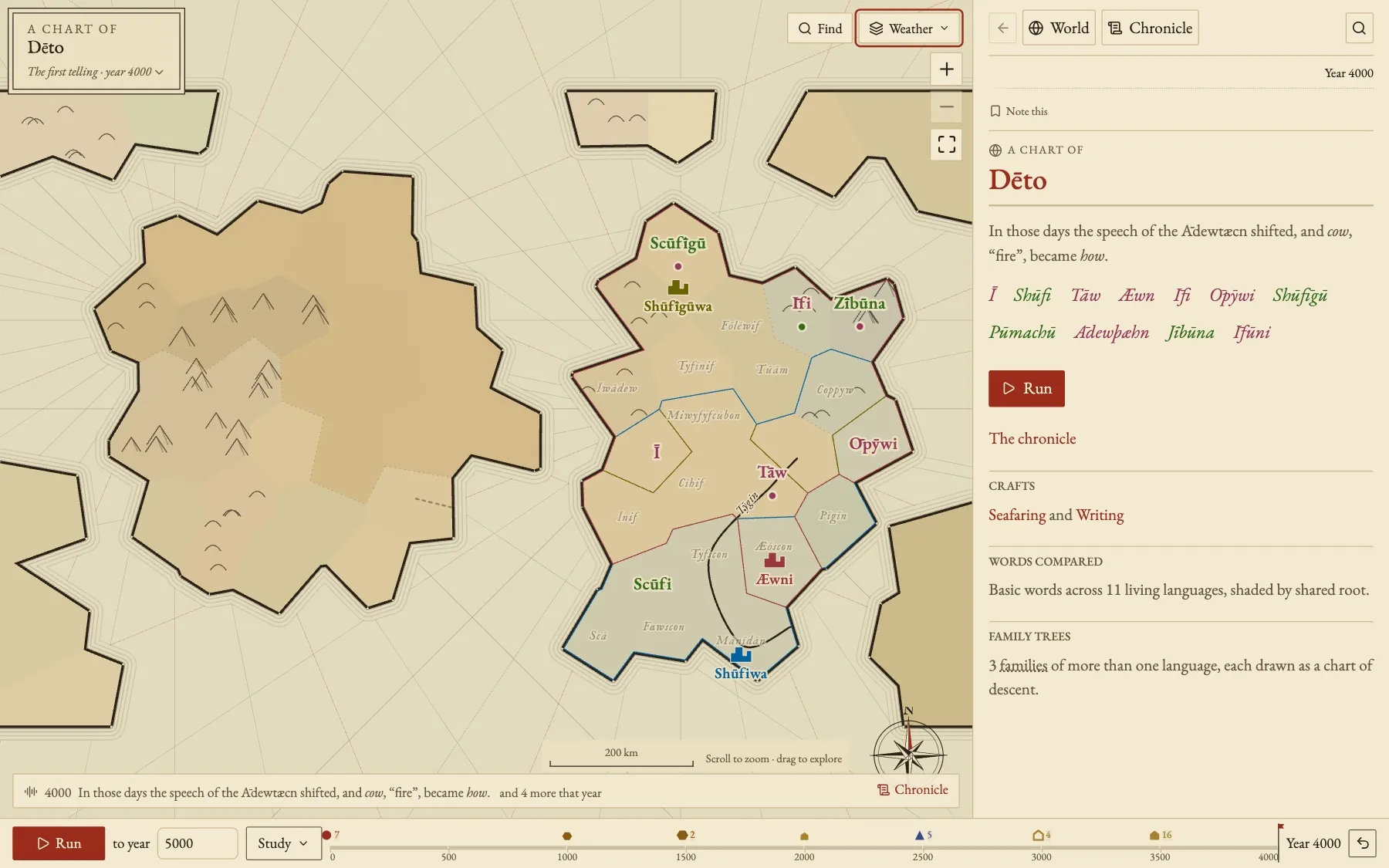
feat(web): rebuild the workbench as the book of a world
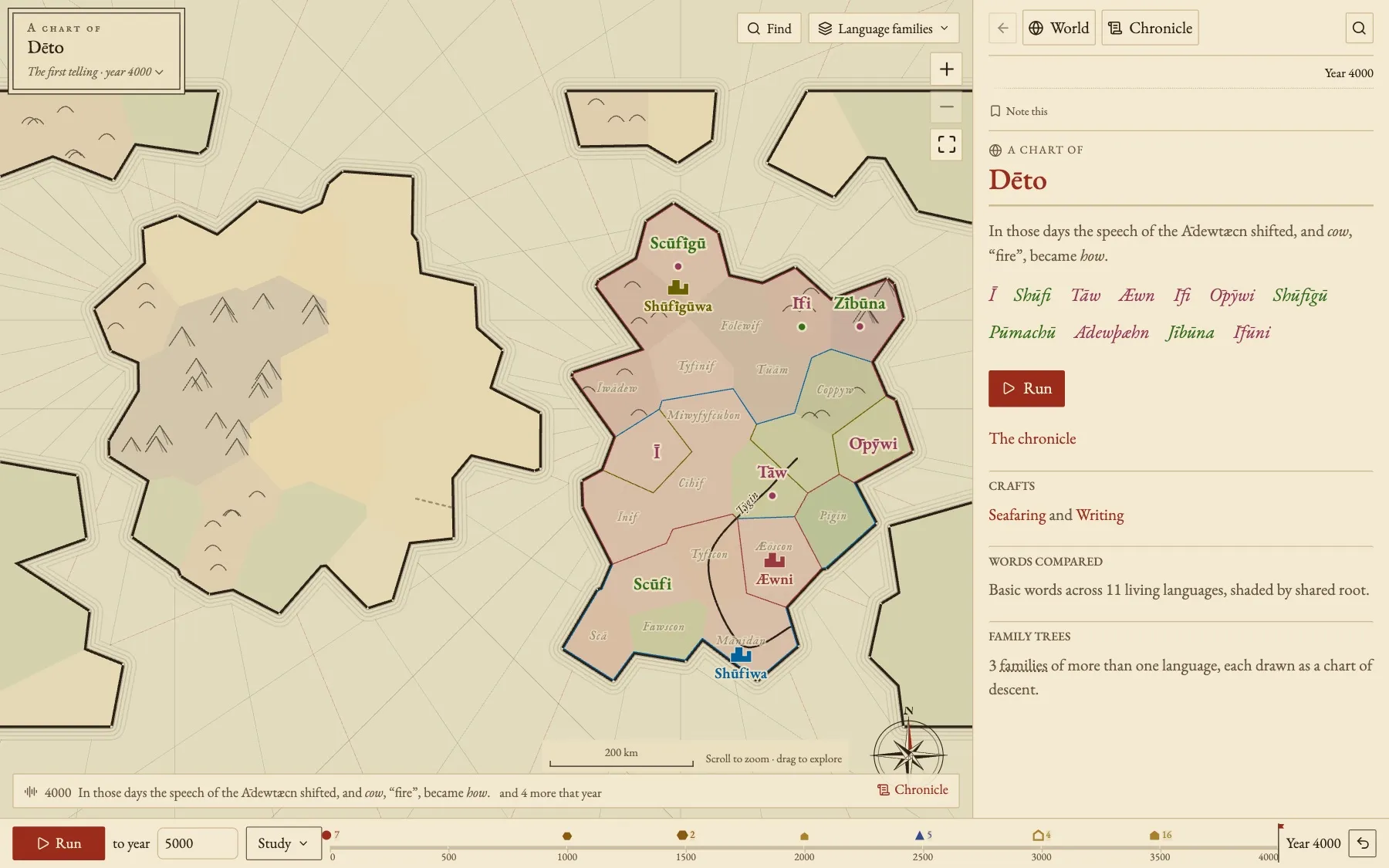
fix(web): polish the four screens at full width
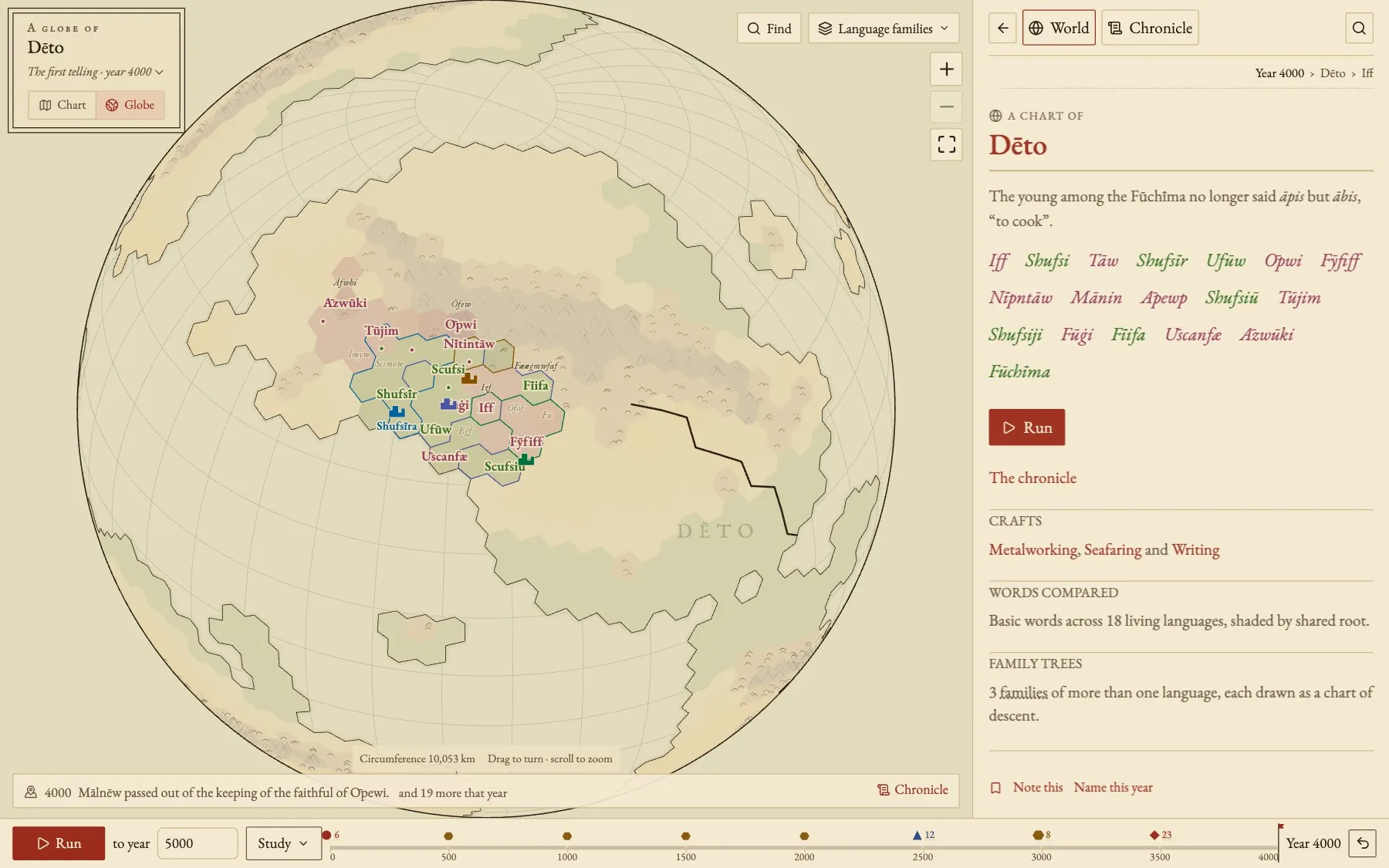
feat: make the world a sphere, read as a chart or a globe
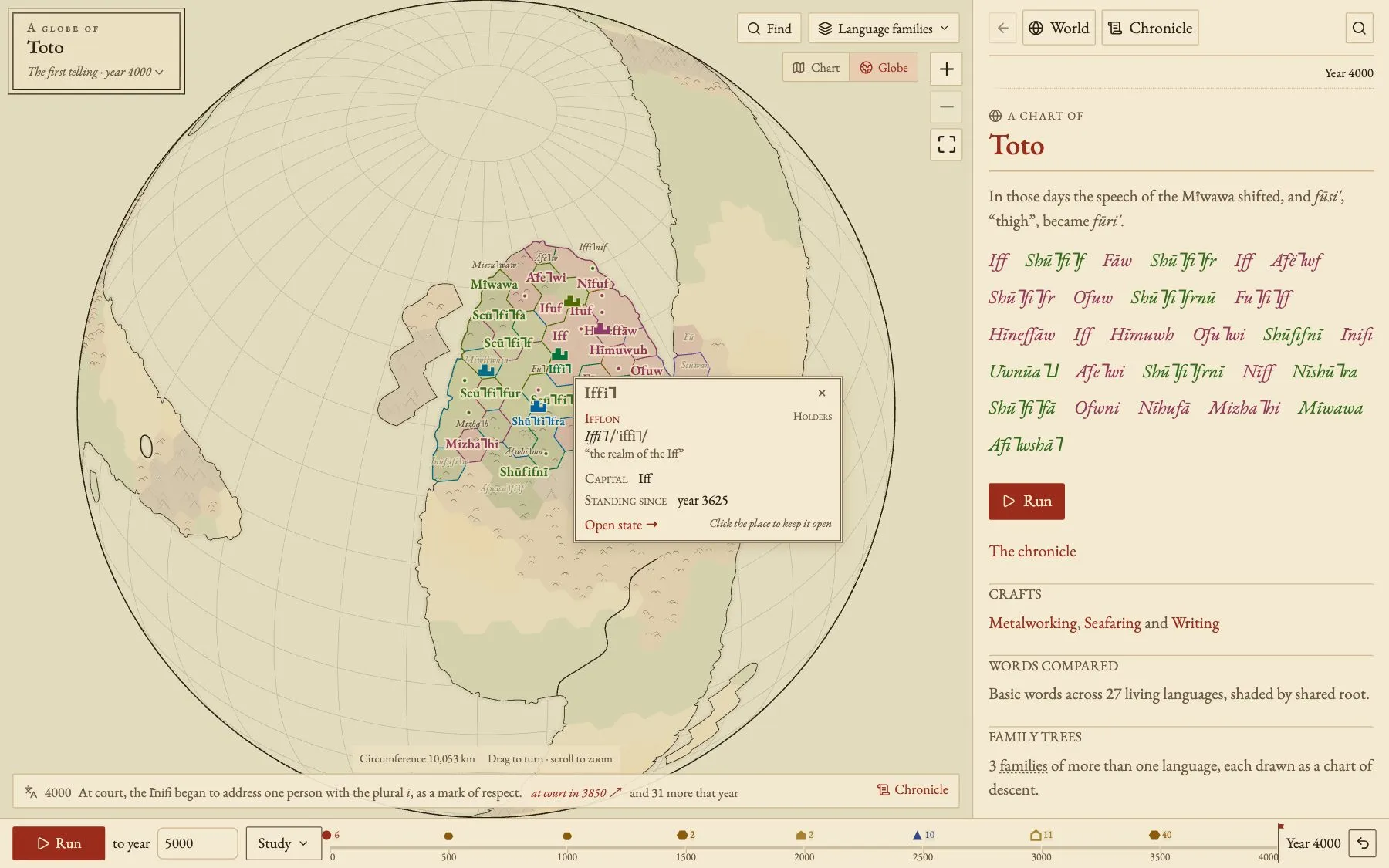
feat(web): read the map's places in their own languages
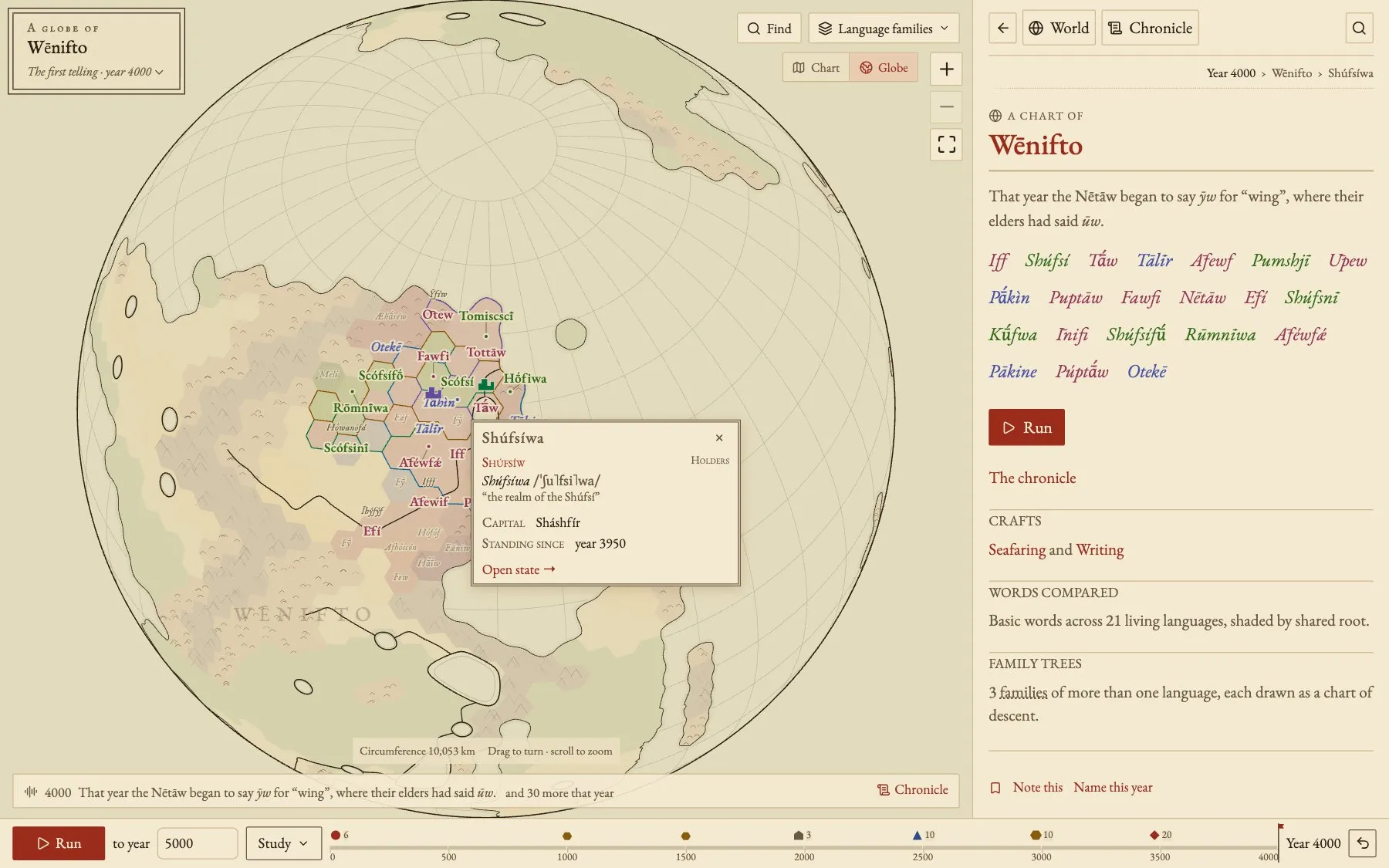
docs: describe place-led founding and plate-drift worlds
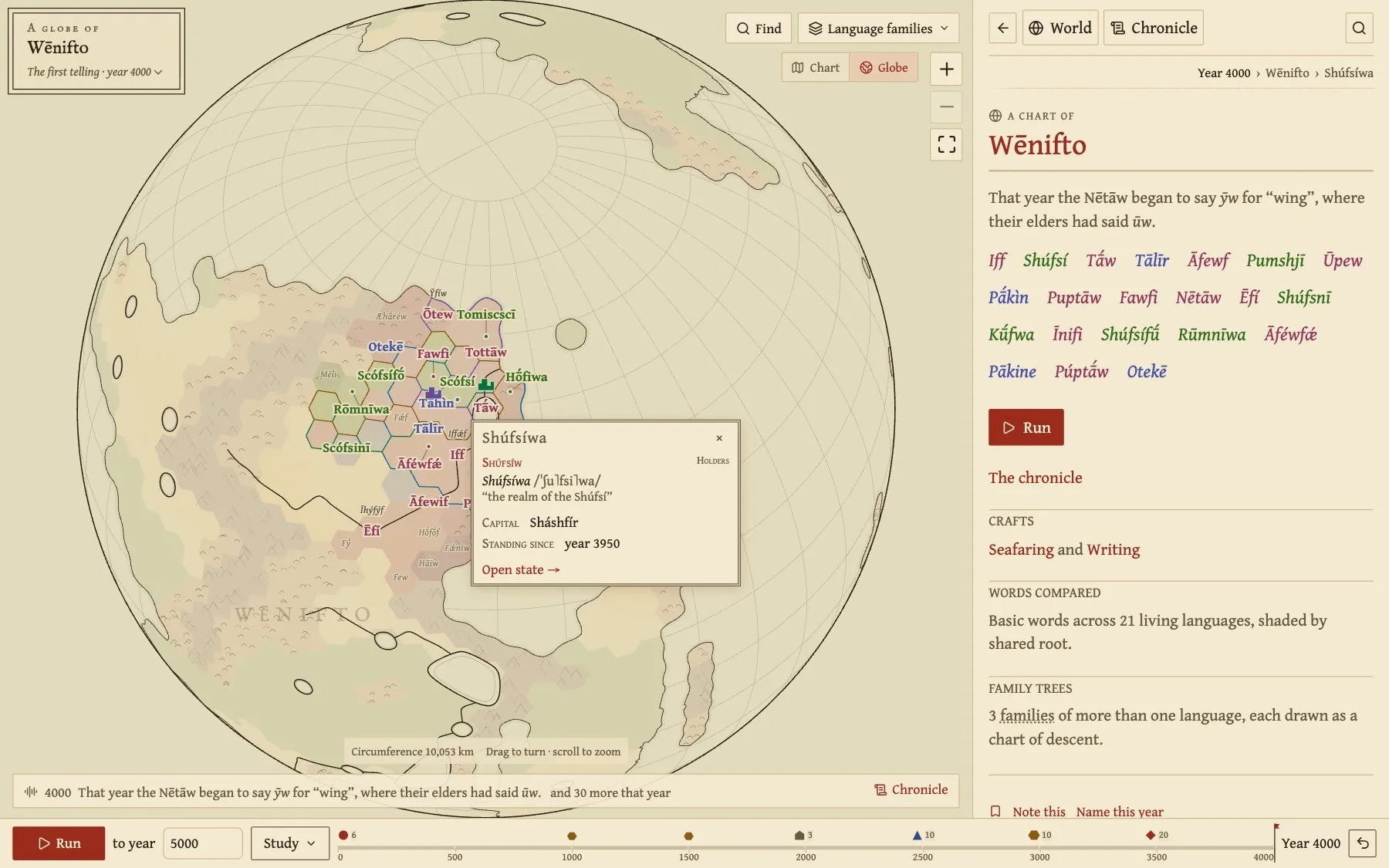
fix(web): letter names in one face that draws every mark
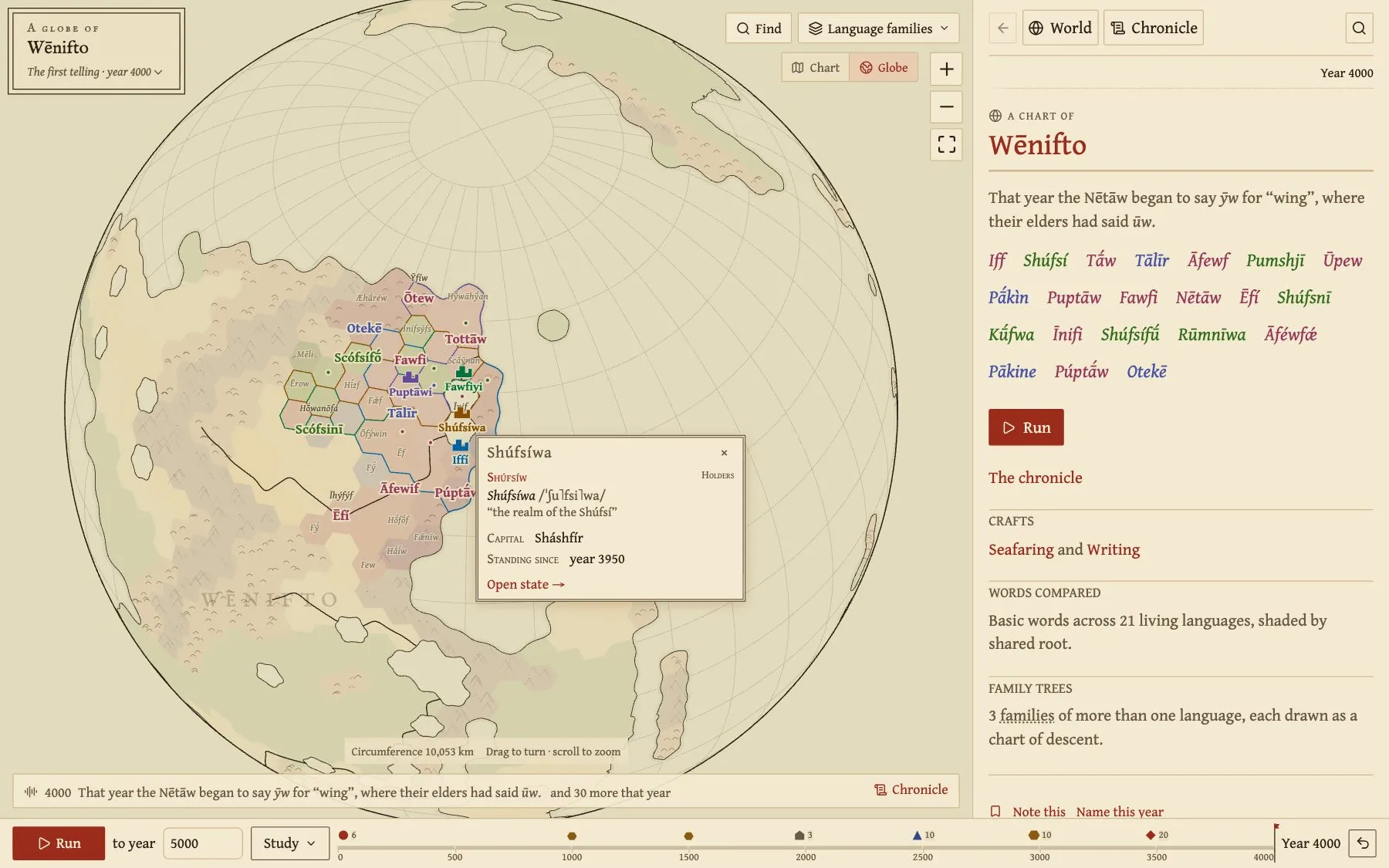
docs: retake the stage screenshot with names in place and new lakes
Open the image to read its full-size frame.
Without JavaScript, the sequence shows the September workbench, the first archived stage and the latest stage.
Once the map arrived, it stayed the stage beneath the reading. Long material moved over it instead of being forced into the side column. Actions moved toward their subjects. Time became a drawn record with entries to follow, rather than only a playback control.
These continuities do not mean the interface is finished. At the end of the month I was still asking how a person should use the chronicle, and noting that its timescale needed more thought.1212The quality pass on the map, cards and founding, 5 October. The current arrangement gives that discussion something concrete to work on. The project entry keeps the shorter account of the simulator and where to try it.
Footnotes
-
Git dates use Pacific time, UTC−07:00. Screenshot commits identify recorded states, not first implementations. The September workbench was rendered from
44a6c3eon 6 October, in its default initial state. ↩ -
6 September:
5b7213a,3ec3404,44a6c3e. Chronicle:a22f169, 30 September. Book spread:2e0e7ef, 1 October. ↩ -
Atlas:
dd812f5; stage:b1e0302. Documentation commit003e2d1saved the reproduced screenshot on 1 October. ↩ -
The agent’s notes from that evening mark which of the mock’s details were placeholders. ↩
-
Chart:
67bde57; offline app:0b9ddb8; astrolabe:4e2c9d5, all 1 October. Custom installation notices were removed ine4b823c. ↩ -
Two-option mock on 1 October; implementation:
caa294f. ↩ -
615d88aandea2746c, 2 October. Before screenshot:6bda82d, 1 October. ↩ -
Product frame:
docs/book.md,04ce2c5; implementation:499f92d. ↩ -
Era direction:
19158a9; implementation:788353e; apparatus scale:cc638be, 2 October. Seedocs/book.md. ↩ -
Accounts:
0c833f2. Later contracts:docs/book.mdanddocs/history.md. Click-to-move:e4cfcea, after the final setup screenshot in5d5be5e. ↩ -
Sphere:
6349888, 3 October; gazetteer:dd9927c, 4 October; plate drift:fbbb78c, 5 October; final screenshot:03e1c9b, 6 October. SeeREADME.md,docs/engine.md,docs/history.md. ↩ -
The quality pass on the map, cards and founding, 5 October. ↩
Linked from · 1
UmranProject
…2026 as a toolkit for naming the peoples of Underlord, a shelved isometric RPG, and I have been building it out with coding agents since. How Umran's interface took shape traces the first month's layout decisions through redrawn wireframes and the screenshots kept in the repository. The source is public, and…